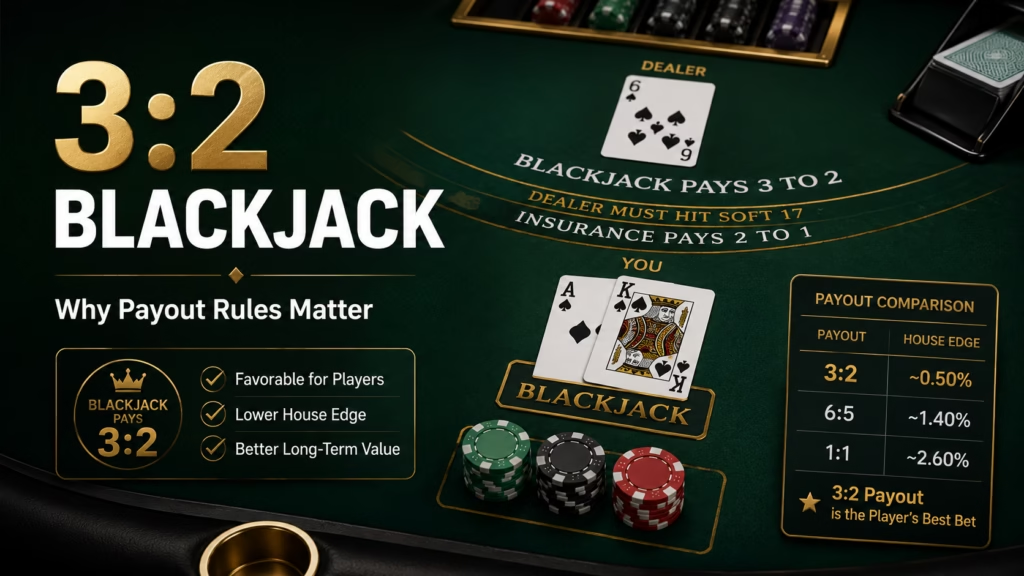
If you are trying to understand what is 3:2 blackjack, the short answer is simple: it is the standard blackjack payout where a natural blackjack pays 3 to 2 in profit. That payout rule matters more than many beginners realize, because it affects your bankroll every time you are dealt the best possible hand in the game.
In both land-based and online blackjack, the payout structure is one of the clearest signs of whether a table is player-friendly or not. A 3:2 table is usually considered the fairer choice, while 6:5 tables give back less for the same winning hand. Over time, that difference adds up, which is why smart players check the rules before they sit down or place a bet.
Blackjack is still a chance-based casino game with financial risk. Even at a 3:2 table, the house keeps an edge. The goal here is not to promise profit. It is to show you how payout rules work, how to compare tables, and why the rule set you choose can change the long-term value of every hand you play.
What is 3:2 Blackjack?
In blackjack, a natural blackjack means your first two cards total 21, usually with an ace and a ten-value card. On a 3:2 table, that hand pays 3 units for every 2 units wagered in profit. So if you bet $10 and get a natural blackjack, you win $15 in profit and receive your original $10 stake back as part of the total payout.
Here is the simplest way to think about it:
- $10 bet at 3:2 = $15 profit
- $20 bet at 3:2 = $30 profit
- $100 bet at 3:2 = $150 profit
That payout is considered the industry standard for a good blackjack game. It does not make the game easy, and it does not remove the house edge. But it does preserve more value for the player than a worse payout table.
By contrast, many modern tables use a 6:5 payout. That means the same natural blackjack pays only 6 units for every 5 wagered in profit. On a $10 bet, that is $12 in profit instead of $15. You are being paid less for the same rare and valuable hand.
The difference may sound small at first, but blackjack hands happen repeatedly. A rule that trims your payout on a premium hand changes the math of the entire game.
Blackjack Payout Impact Calculator
Use this simple calculator to see how much a 6:5 table cuts into the value of a natural blackjack compared with a 3:2 table. This calculation illustrates payout differences only; it does not guarantee wins or account for house edge variations in other game rules.
Result for a natural blackjack
| Bet Amount | 3:2 Payout Profit | 6:5 Payout Profit | Difference |
|---|---|---|---|
| $100 | $150 | $120 | $30 |
Calculator note: If you want the total return including your original stake, add the bet back to the profit figures shown above.
Why Payout Rules Change the Game
 Payout rules affect the house edge, which is the built-in mathematical advantage the casino has over the player. In blackjack, the house edge is not just about one rule. It comes from the full rule set: blackjack payout, dealer behavior, doubling rules, split rules, and whether the dealer hits or stands on soft 17.
The payout on a natural blackjack matters because blackjacks are one of the strongest outcomes in the game. When a casino pays less for that hand, it reduces the player’s expected return. That lowers the game’s RTP, or return to player, which is the long-run percentage of wagered money the game is expected to pay back across huge numbers of hands.
For a typical player, the practical effect is simple: a 6:5 table is more expensive to play than a 3:2 table. Many blackjack references note that moving from 3:2 to 6:5 can increase the house edge by around 1.39 percentage points or more, depending on the rest of the rules. That is a major shift in a game where even small rule changes matter.
It also affects bankroll longevity. At a worse payout table, your money tends to last for fewer hands because the game is taking a larger cut from the most valuable winning result. That does not mean you lose every session, but it does mean the long-term cost of play is higher.
Comparison: 3:2 vs 6:5 Payouts
The table below shows how the payout difference works on common bet sizes. The “Cost” column shows how much less profit you receive on a 6:5 table when you hit a natural blackjack.
| Bet Amount | 3:2 Payout | 6:5 Payout | The Cost of Playing 6:5 |
|---|---|---|---|
| $10 | $15 profit | $12 profit | $3 less |
| $25 | $37.50 profit | $30 profit | $7.50 less |
| $50 | $75 profit | $60 profit | $15 less |
| $100 | $150 profit | $120 profit | $30 less |
| $200 | $300 profit | $240 profit | $60 less |
If you play multiple blackjacks in a session, those differences stack up quickly. Even if a player only sees a handful of natural blackjacks in a night, the payout rule still changes the expected value of each one.
That is why many experienced players treat table selection as part of bankroll management. They do not just look at the minimum bet or the atmosphere. They check the payout rule first.
How to Spot the Right Blackjack Table
Whether you are playing in person or online, learning how to identify the payout rule is a valuable skill. Think of it as table scouting: you are checking the rules before committing money to the game.
What to check at a physical table:
- Look at the felt or the posted table rules.
- Find the payout line for blackjack before you sit down.
- Confirm whether the table says 3:2 or 6:5.
- Check whether other rules also affect value, such as dealer hits soft 17.
What to check in an online game:
- Open the game’s Info, Help, or Rules menu.
- Look for the blackjack payout in the paytable or rules screen.
- Check whether the game uses 3:2, 6:5, or another special payout structure.
- Review the full rules before your first wager, not after.
Being a table scout is not about chasing a secret edge. It is about avoiding avoidable losses. A player who checks the rules first can make a better choice than a player who sits down without reading the table.
One common mistake is assuming all blackjack tables are the same. They are not. Two tables can look identical on the surface and still have very different math underneath.
The Reality of the House Edge
3:2 blackjack is better than 6:5, but it is still not a “safe” game in the long run. The house edge remains, which means the casino has a statistical advantage over millions of hands. That edge may be small at a favorable table, but it never disappears just because the payout is 3:2.
It helps to think about blackjack in terms of expected value instead of session results. In the short term, almost anything can happen. A player can win a series of hands, lose a series of hands, or see several blackjacks in a short session. But over a very large sample, the house edge and RTP tell the true story of the game’s math.
Other rules can make a table better or worse alongside the payout rule:
- Dealer hits soft 17: usually worse for the player than standing on soft 17.
- Double after split: usually better for the player if allowed.
- Late surrender: can reduce losses in certain situations.
- Number of decks: can also influence the overall house edge.
This is why the payout rule should not be viewed in isolation. A 3:2 table with poor companion rules may still be worse than another 3:2 table with more favorable rules. Still, if you are comparing a 3:2 table to a 6:5 table, the 3:2 option is usually the better choice for bankroll longevity.
Most importantly, no payout rule makes blackjack a guaranteed-profit game. The math is based on probability across millions of hands, not on any one player’s session. That is why responsible expectations matter as much as rule selection.
Responsible Gambling and Table Selection
If you play blackjack, choosing a 3:2 table is a sensible bankroll decision. You are not trying to force a win; you are simply avoiding a worse payback structure when a better one is available.
A few practical habits can help keep play safer and more controlled:
- Set a budget before you play and stick to it.
- Prefer games with clearer, player-friendlier rules.
- Do not chase losses after a bad run.
- Take breaks so your decisions stay deliberate.
- Verify local laws, age limits, operator licensing, and game rules before depositing or sitting down.
If an operator only offers 6:5 blackjack and you have another option, consider choosing a different game or a different operator. That is a responsible selection choice, not a strategy to beat the house. It simply keeps more of your money in play when a blackjack occurs.
When reading any casino game description, remember that RTP is theoretical. Real results can differ sharply from the long-run average in a single session. The safest approach is to understand the rules, choose the better table when possible, and treat the game as entertainment with a cost.
FAQ
Is 3:2 better than 6:5?
Yes. A 3:2 table pays more for a natural blackjack, so it gives the player better value and a lower house edge than 6:5.
How do I know if an online game is 3:2?
Check the game’s Rules, Help, or Info section, or the paytable. It should clearly state whether blackjack pays 3:2, 6:5, or another ratio.
Does 3:2 blackjack mean I will win more often?
No. It means you are paid more when you hit a natural blackjack. It does not change how often you receive that hand.
Are there 2:1 blackjack games?
They are rare. When they appear, they are usually tied to special promotions, side bets, or bonus-style rule sets rather than standard blackjack.
What should I do if a casino only offers 6:5?
If possible, find a different blackjack table or a different operator. A 3:2 table is generally better for your bankroll than 6:5.