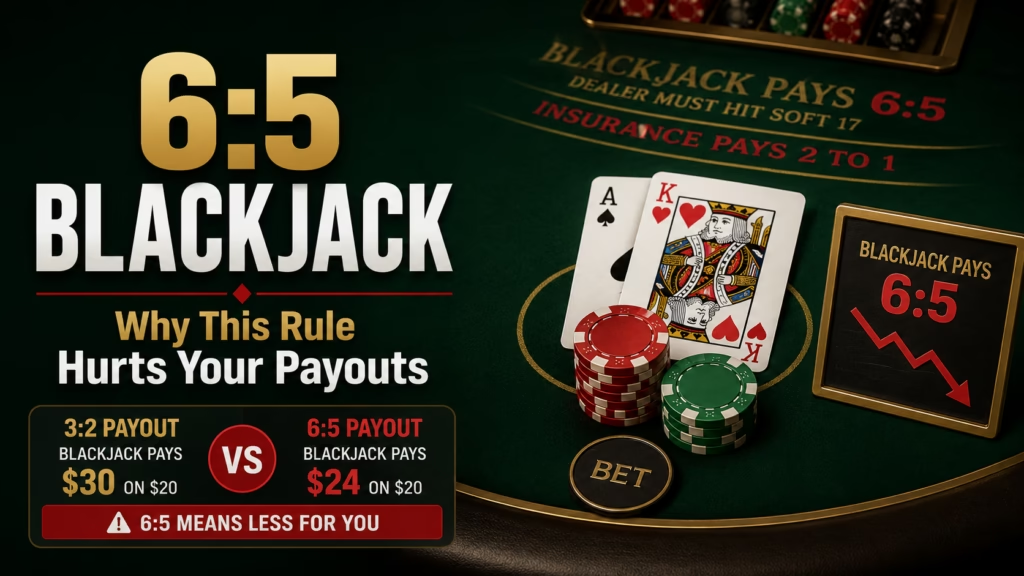
Not all blackjack tables are equal. If you are asking what is 6:5 blackjack, the short answer is that it is a payout rule that pays less for a natural blackjack than the standard 3:2 game. That single change may look small on the felt, but it has a real effect on your bankroll over time.
In a standard 3:2 game, a natural blackjack pays 3 units for every 2 wagered. In a 6:5 game, it pays 6 units for every 5 wagered. That means a $10 blackjack pays $15 in a 3:2 game, but only $12 in a 6:5 game. The difference may seem minor at first, but for players who sit for multiple hours, it adds up fast.
The goal here is simple: help you understand why this rule change is widely viewed as a worse deal for players, how it changes the house edge, and how to spot these tables before you buy in. Blackjack is still a game of chance, and no betting system can turn a poor payout rule into a good one.
Defining the 6:5 Blackjack Rule
The 6:5 blackjack rule changes the payout on a natural blackjack, which is an ace plus any ten-value card dealt as your first two cards. In a normal 3:2 game, that winning hand pays 1.5 times your bet. In a 6:5 game, it pays 1.2 times your bet.
Here is the simplest way to think about it:
- 3:2 blackjack: a $10 natural blackjack pays $15 total profit.
- 6:5 blackjack: a $10 natural blackjack pays $12 total profit.
The key point is that this is not a side bet, bonus, or optional feature. It is a house rule. Once you sit down and place chips on a 6:5 table, that payout structure is built into the game and is not negotiable.
For casual players, this often gets missed because the rest of the game may look familiar. The dealer still deals cards the same way, and basic blackjack rules may seem standard. But the payout for the best possible starting hand is reduced, and that changes the economics of the game in the casino’s favor.
The Math: Why 6:5 Increases the House Edge
 The real problem with 6:5 blackjack is not just that it pays less on one hand. The issue is how often that hand appears and how much value it removes from the player over time.
Blackjack naturally occurs about once every 21 hands on average. That frequency can vary in the short run, but over many hands it is a reasonable benchmark used in blackjack math. Every time a natural blackjack appears, the player in a 6:5 game gives up $3 on a $10 bet compared with a 3:2 game.
That extra loss happens repeatedly across a session. If you play for an hour and see several naturals, the lower payout chips away at your expected return even if you play perfectly otherwise. The rule does not just reduce a single payout; it lowers the value of one of the strongest hands in the game.
Breaking Down the House Edge Shift
In standard blackjack, the house edge can be very low when the rules are player-friendly and you use basic strategy. When a table switches from 3:2 to 6:5, the house edge usually rises by roughly 1.4% to 2%, depending on the rest of the rules. That is a big jump in a game where small rule changes matter a lot.
To put that in perspective, a table that might have been around a 0.5% house edge under good conditions can move into the 2% to 2.5% range once 6:5 payouts are added. Exact figures vary by deck count and other rules, but the direction is always the same: the casino gains a larger built-in advantage.
That increase matters because blackjack players often choose the game for its relatively low house edge. A 6:5 payout weakens that edge substantially. Even if you make the right decisions at the table, you are still starting from a worse mathematical position than you would in a 3:2 game.
House edge note: the exact edge depends on all the table rules, not just payout. Still, 6:5 is widely recognized in gaming math as one of the most player-unfriendly rule changes in modern blackjack.
| Rule | Natural blackjack payout | Example on $10 bet | Player impact |
|---|---|---|---|
| 3:2 | 1.5x | $15 profit | Standard payout |
| 6:5 | 1.2x | $12 profit | $3 less per blackjack |
That $3 difference is the part many players underestimate. You do not lose it on every hand, but you do lose it every time you get one of the game’s best possible hands. Over a long session, that is a meaningful hit to expected value.
Payout Impact Comparison Box
Select your bet size:
| Bet Size | 3:2 Payout | 6:5 Payout | Difference |
|---|---|---|---|
| $10 | $15 profit | $12 profit | $3 less on a natural blackjack |
| $25 | $37.50 profit | $30 profit | $7.50 less on a natural blackjack |
This reflects the difference in payout only. All blackjack games involve a house edge.
How to Spot 6:5 Games at the Casino
The best time to avoid a 6:5 table is before you sit down. Casinos usually make the payout rule visible, but it is easy to miss if you are focused on the minimum bet or the crowd around the table.
Look closely at the table felt, the table plaque, and any small sign near the betting area. The payout rule is often printed directly on the layout, sometimes near the table name or in a rules box. If you see “6:5” anywhere, that is your cue to think twice before buying in.
It also helps to slow down and read the table before placing chips. A dealer will usually not explain the payout rule unless asked, and many players assume the game is standard until they notice the small print. Observing the signage before you sit is one of the simplest ways to protect your bankroll.
| Indicator | What to look for | Risk Level |
|---|---|---|
| Table Felt | Printed “6:5” near the betting area or rules text | High |
| Signage | Payout rules on the table plaque or nearby sign | High |
| Dealer Procedures | Dealer confirms natural blackjack pays 6:5 when asked | High |
One practical habit: ask the dealer, “What does blackjack pay here?” If the answer is anything other than 3:2, you know the table is not the standard game many players prefer. This quick question can save you from sitting down at a worse payout table by mistake.
Does Any Strategy Mitigate the 6:5 Rule?
 Not really. Basic strategy still matters because it helps you play each hand as well as possible, but it cannot fix a payout rule that already takes value away from your strongest hands.
That distinction is important. Strategy can reduce mistakes, but it cannot change the built-in math of the game. If the table pays less on blackjack, the casino has already built in a larger advantage before the first card is dealt.
Some players choose to avoid 6:5 tables entirely and wait for a 3:2 game instead. That is often the simplest response if your goal is to preserve value. If you do play a 6:5 table because of the minimum bet or limited options, it is best to understand that you are accepting a weaker game, not solving it.
Card counting does not magically erase the payout penalty either. In theory, advantage players care about many rule details, but for most casino visitors the easiest and most realistic choice is still to avoid the 6:5 table when possible.
Why Casinos Offer 6:5 Tables
Casinos offer 6:5 tables because the rule improves their expected revenue while allowing them to market lower minimum bets. From an operational perspective, it gives them flexibility. A casino can advertise a $5 or $10 blackjack table while still keeping the long-term game more profitable for the house.
This is not unusual in casino design. Operators often balance game appeal, table availability, and revenue targets. A lower minimum can attract more players, especially during busy periods or on the casino floor where budget-friendly games look inviting.
The trade-off is that the player is receiving a less favorable payout structure in exchange for the lower buy-in. That is why it is so important to read the table rules, not just the minimum bet. A cheap entry price does not always mean a better game.
If you care about value, compare the full rules before you sit down. Check the blackjack payout, number of decks, dealer hit or stand rules on soft 17, surrender options, and whether doubling after splitting is allowed. Those factors all affect the house edge, but the 6:5 payout is one of the clearest warning signs.
FAQ
What is the main difference between 3:2 and 6:5 blackjack?
The main difference is the payout for a natural blackjack. A 3:2 game pays $15 profit on a $10 bet, while a 6:5 game pays $12 profit on the same bet.
Is 6:5 blackjack worth playing if the table minimum is lower?
It can be tempting, but the lower minimum does not remove the worse payout rule. If you want the better value, a 3:2 table is usually the better choice whenever one is available.
Can I use card counting to beat 6:5 blackjack?
Card counting does not remove the 6:5 payout disadvantage. While advanced players may consider many rule details, the reduced blackjack payout still makes the game less favorable overall.
Are all 6:5 blackjack games the same?
No. A 6:5 payout is only one rule. Other factors such as number of decks, dealer rules, surrender options, and doubling rules can also change the house edge.
How can I find 3:2 blackjack tables in a casino?
Check the felt, the table plaque, or the rules sign before sitting down. If the payout is not clearly marked as 3:2, ask the dealer directly before you buy in.
Does the 6:5 rule affect the dealer’s rules?
No. The 6:5 rule changes only the payout for player blackjacks. Dealer drawing and standing rules are separate and can vary by table.
Before playing, remember that blackjack involves financial risk and outcomes are based on chance. If you are gambling, set a budget, know the table rules, and check local laws, age requirements, and the operator’s license before you play.