Juggling between choices and preferences for online casino games can be difficult for players. If you are a hardcore gaming enthusiast, the situation can sometimes lead to Choice paralysis in online gaming. During a short break from the office, it becomes important to play for a limited time but make that time worthwhile.
This is where selecting the right game matters. Blackjack may seem like the obvious option, but sometimes it is better to explore other games as well. It is not always possible to find the perfect game to start with or continue playing. However, choosing the best option among many available games is something every hardcore player needs to learn.
I remember when logging into an online lobby felt like walking into a neon-drenched fever dream from 2005. It was all clunky buttons and music that sounded like a broken MIDI file. Fast forward to 2026, and the landscape is unrecognizable. We’ve got haptic feedback on our phones, dealers streaming in 4K from studios that look like high-end boutiques, and algorithms that actually seem to understand we’re here for a good time, not just to be drained.
1. The Psychology of the Spin vs. The Strategy of the Seat
There’s a specific kind of “zone” you get into with slots. Psychologists call it “the machine zone,” but most of us just call it “shutting the world out for twenty minutes.” Slots in 2026 aren’t just three cherries and a lever; they’re immersive cinematic experiences.
When you’re looking at mobile slots 2026, the focus has shifted entirely toward “snackable” entertainment. You’re not just betting; you’re unlocking chapters of a story or triggering visual cascades that feel more like a high-end video game than a gambling product. It’s low-friction. You don’t need to memorize a chart or worry about the person sitting next to you “hitting on a 16” and ruining the flow.
Table games are the polar opposite. They demand your presence. Whether it’s Roulette, Baccarat, or the eternal king, Blackjack, you are making decisions that feel—rightly or wrongly—like they have weight. There’s a communal energy there, even online.
Slots: A solo escape. Pure sensory input. Chill, high-variance, and visually loud.Tables: Social, cerebral, and intense. It’s you vs. the math (and sometimes the dealer’s personality).
2. The Math Problem: RTP vs. House Edge
Let’s be real for a second—the math is always going to lean toward the house. If it didn’t, the servers would be shut down by noon. But how that math eats into your bankroll is where the two sides diverge.
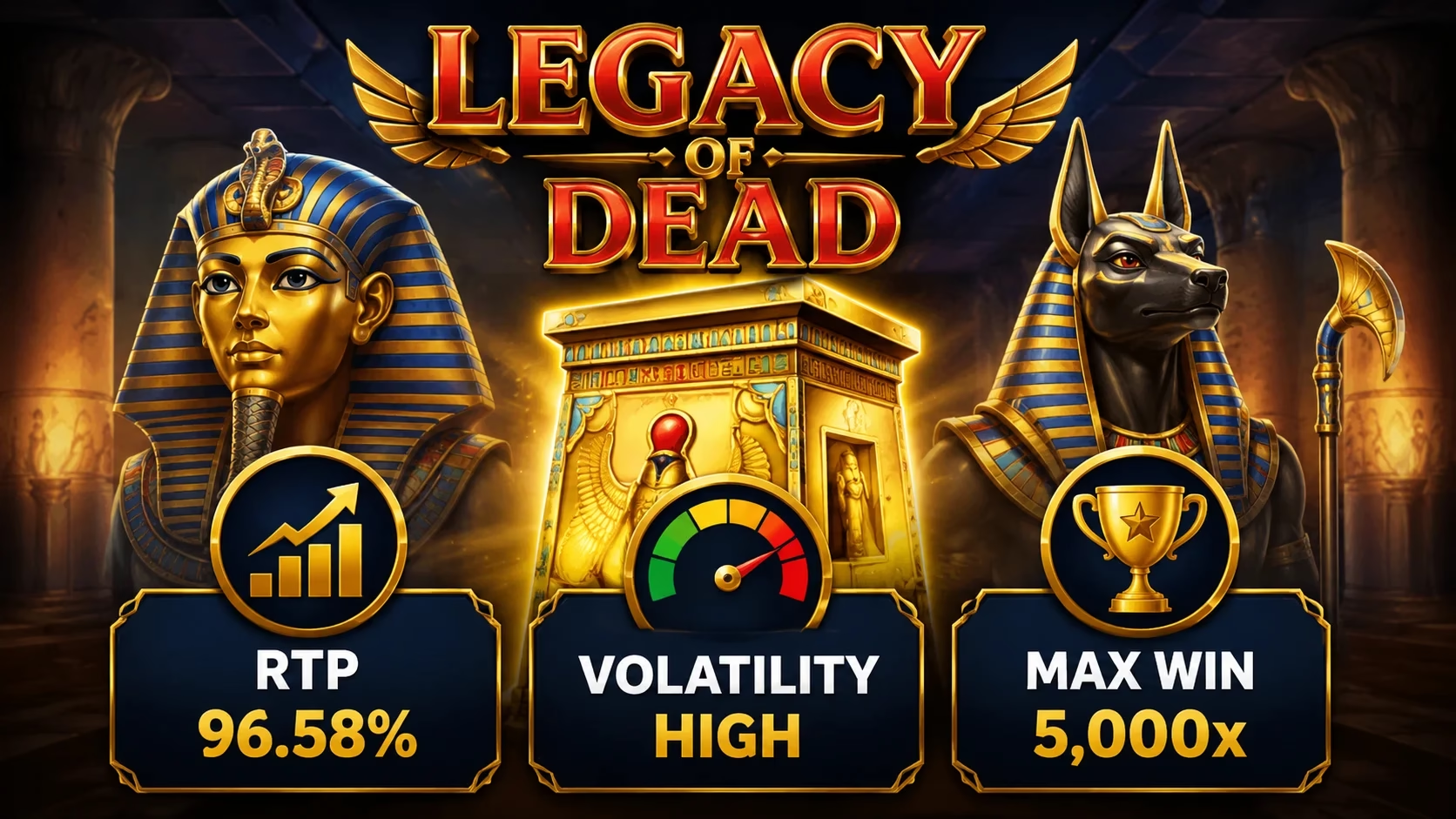
Slots usually carry an RTP (Return to Player) between 94% and 97%. In plain English? For every hundred bucks you put in, you’re “expected” to lose three to six dollars over the long haul. But slots are volatile. You might lose fifty bucks in ten minutes, or you might hit a 5,000x multiplier on your third spin. It’s that “lottery” potential that keeps people coming back.
Table games are a slow burn. If you’re playing a solid live dealer strategy, you can whittle the house edge down to nearly 0.5% in some versions of Blackjack. It’s the closest you can get to a fair fight in this industry. But here’s the kicker: most people don’t play perfectly. They play on a “hunch.” And hunches are exactly how casinos pay for their electricity bills.
Hot Take:
High RTP in slots is often a trap. A 98% RTP slot with “Extreme Volatility” will drain your wallet faster than a 92% RTP slot that pays out small wins every three spins. Don’t chase the percentage; chase the “hit frequency.”
3. The Live Dealer Revolution
I’ve noticed lately that the line between “digital” and “real” has basically evaporated. Five years ago, live dealer games felt a bit laggy and awkward. Now? It’s arguably the most engaging way to play.
The social aspect is the “game-changer” here. You’ve got dealers who are basically entertainers, keeping the chat moving while they flip cards. It mimics the “fair play gaming” atmosphere of a physical floor without the $15 craft beers and the guy blowing smoke in your face.
But there’s a downside. Table games are slow. If you’ve only got ten minutes, you might only see three hands of Blackjack. That’s where slots still dominate. You can rip through fifty spins while waiting for your Uber. It’s about the pace of play. If you want a slow, methodical evening, go for the tables. If you want instant feedback, the reels are your best bet.
Pro-Tip Box:
If you’re playing live tables, watch the “Behind the Bet” or “Hot/Cold” stats for entertainment, but never let them dictate your bet. The deck doesn’t have a memory. Just because the dealer has hit 21 three times in a row doesn’t mean they’re “due” for a bust.
4. The Tech Factor: Payments and Platforms
We can’t talk about the “which is better” debate without talking about how we actually move our money around. In 2026, nobody has time for a “3-5 business day” withdrawal window. That’s a relic of the past.
Modern players are gravitating toward fast payout casinos because the trust gap has closed. If I win on a lucky Roulette spin at 11 PM, I want that money in my digital wallet by 11:05 PM. This instant-gratification loop has actually made table games more popular again. Historically, people stuck to slots because the wins were smaller and easier to process. Now that high-limit table wins move just as fast, the “Big Fish” players are returning to the felt.
Furthermore, crypto gambling trends have completely shifted the privacy landscape. Playing slots with sub-cent Bitcoin or Ethereum denominations allows for a level of micro-betting that was impossible with traditional fiat. You can literally play for hours on the change you found in your digital sofa cushions.
5. Why “Fair Play” Isn’t Just a Buzzword Anymore
Actually, scratch that—it’s always been a buzzword, but now we have the tools to verify it. Whether you’re spinning mobile slots 2026 or playing a high-stakes Baccarat hand, the transparency of the RNG (Random Number Generator) is what matters most.
The industry has moved toward “Provably Fair” systems. This is especially true in the world of crypto gambling trends, where you can actually verify the seed of your spin or hand on the blockchain. It removes that nagging feeling in the back of your head that says, “the game is rigged because I haven’t hit a bonus in an hour.”
Usually, the “rigged” feeling comes from a misunderstanding of variance. Slots are designed for “clumped” wins. Table games are designed for “streaks.” Understanding which one your personality can handle is the key to not losing your mind.
The Vibe Check:
Verification: In 2026, if a platform doesn’t let you audit the game’s fairness, it’s not worth your time. The “Black Box” era of gambling is dead.
6. The “Hidden” Costs: Time and Focus
One thing people rarely discuss is the “cognitive load” of these games.
If I’m playing a complex live dealer strategy, I’m tired after an hour. My brain is fried from calculating outs and managing my bankroll. It’s “work” disguised as play.
Slots, on the other hand, are the ultimate “no-brainer.” You can listen to a podcast, watch a movie, or even cook dinner while the “Auto-Play” feature does its thing (responsibly, of course). It’s passive.
But this passivity is a double-edged sword. Because you aren’t “doing” anything, it’s much easier to lose track of time—and your budget. Table games have natural “break points.” The dealer changes. The deck is shuffled. Someone leaves the table. These are tiny psychological resets that remind you that you’re in a real-world transaction. Slots don’t have those resets; they are designed for “flow,” and flow can be dangerous if you aren’t disciplined.
Hot Take:
Auto-play is the most dangerous button in the casino. It strips away the decision-making process, which is the only thing that actually makes gambling a “game” rather than a “donation.”
7. Integrating the “Safety First” Mindset
Look, we’re all adults here. We know the score. Gambling is a luxury expense, like a concert ticket or a fancy dinner. The second it becomes a “necessity” or a way to “fix” a financial problem, the game is over—and you lost.
The best way to enjoy fair play gaming is to set hard limits before you even open the app. I’ve found that the most successful “savvy” players I know use “Session Timers.” When the phone pings at 30 minutes, they close the tab. Period. No “one last spin,” no “let me win back that last tenner.”
Whether you’re into the flashy graphics of the newest slot or the gritty realism of a live Blackjack table, the house always has the edge. Your only edge is your ability to walk away when the fun stops. That sounds like a cliché because it is—but clichés exist because they’re true.
The Final Verdict (If There Even Is One)
So, slots or table games?
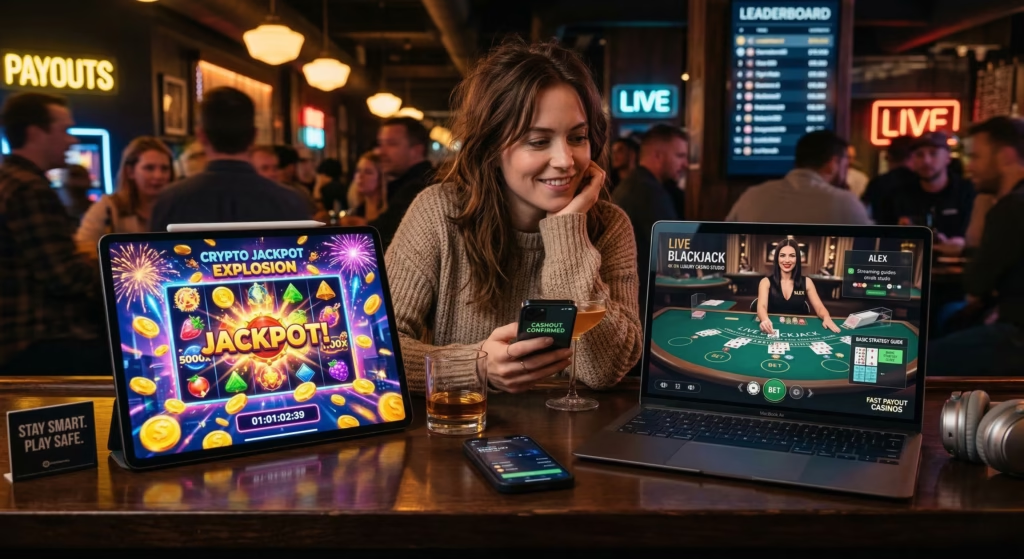
If you want to turn your brain off and potentially hit a massive, life-changing multiplier for the price of a coffee, you’re a slots person. You’re here for the spectacle. You want to see the screen explode with gold coins and digital fireworks.
If you want to feel like you’re in control, even if that control is a mathematical illusion, you’re a table games person. You want the banter, the strategy, and the slow-burn tension of the turn of a card.
In 2026, the tech has made both options incredible. With fast payout casinos handling the backend, the “stress” of the experience is mostly gone. It really just comes down to who you want to be that night: the lone wolf chasing a jackpot, or the strategist at the table.
Personally? I’ll take a few rounds of Roulette to start the night—just for the drama—and then finish off with some low-stakes slots while I wind down. But that’s just me. The only “better” choice is the one that doesn’t make you regret checking your bank account the next morning.
Keep it light, keep it smart, and remember: the house doesn’t need your money as much as you do.
FAQs: The Stuff You’re Actually Wondering
Which has better odds for a beginner?Hands down, table games—if you stick to the basic bets (like Red/Black in Roulette or “Pass” in Craps). However, slots are “safer” for beginners in terms of complexity. You can’t make a “wrong” move in a slot game, whereas a bad move in Blackjack can be embarrassing at a live table.
Is there really a strategy for slots?Not for the spin itself. Every spin is an isolated event. The only real “strategy” is bankroll management. Choosing games with a higher hit frequency or lower volatility can make your money last longer, but you can’t “beat” the machine.
Why are live dealer games so popular right now?Because humans crave connection. After years of playing against cold, sterile computer interfaces, having a real person talk to you while you play makes the whole thing feel more “legit.” It’s about trust and entertainment value.
Can I play these on my phone without losing quality?In 2026, yes. Most games are built “mobile-first.” In many cases, the interface on a high-end smartphone is actually more intuitive and smoother than the desktop version.
What’s the deal with "Provably Fair"?It’s a technical way of saying the casino has “showed its work.” Using cryptographic hashes, players can verify that the outcome of a game was determined before the bet was placed and wasn’t altered by the house. It’s the gold standard for transparency