I’ve noticed lately that wagering requirements aren’t even trying to hide anymore.
Back in the day, they were buried deep in terms and conditions—tiny text, hard to find, easy to ignore. Now? They’re right there in the open… but dressed up just enough to still confuse people.
“30x bonus.”
“40x playthrough.”
Sounds harmless. Almost casual.
It’s not.
Because if you’ve ever actually tried to clear one, you already know—it’s not about understanding the number. It’s about surviving it.
So let’s break this down properly. No fluff. No casinCasino Affiliateo marketing spin. Just the reality of how wagering works—and why it rarely plays out the way people expect.
What Wagering Requirements Actually Mean
I remember when I first saw a “35x wagering requirement” and thought, okay, that’s manageable. I had no idea what I was agreeing to.
Here’s the simple version:
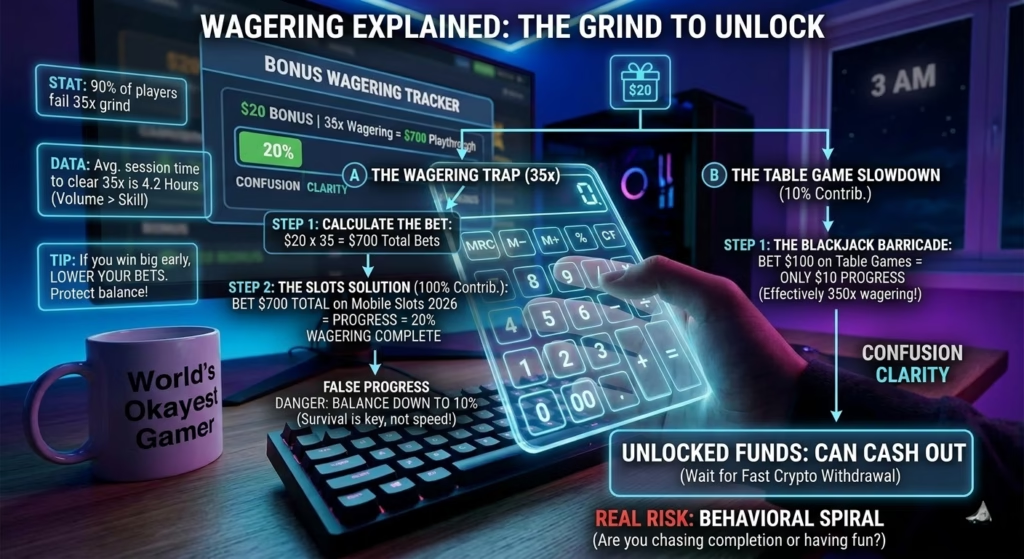
A wagering requirement is how many times you have to bet your bonus before you can withdraw anything.
That’s it.
No tricks in the definition. The complexity comes from everything around it.
Let’s say you get:
- $20 bonus
- 30x wagering
You need to place $600 worth of bets before you can cash out.
Vibe Check
Confusion turning into clarity. It sounds simple, but the scale hits different once you do the math.
Why Casinos Use Wagering (And Why It’s Not Optional)
I’ve noticed people ask this a lot:
“Why not just give free money without conditions?”
Short answer? Because casinos aren’t charities.
Long answer? Wagering requirements exist to protect the casino’s edge.
Even in systems built around fair play gaming, where outcomes are statistically balanced and regulated, the house still has a slight advantage over time.
Now imagine giving out bonuses with no strings attached.
Players would:
- Sign up
- Grab the bonus
- Withdraw immediately
Game over. For the casino.
So wagering acts like a filter. It ensures:
- Players actually engage with the platform
- The house edge has time to work
- Bonuses don’t turn into instant losses for the operator
Hot Take
Wagering requirements aren’t there to challenge you—they’re there to protect the casino from you.
Once you see that, everything starts making sense.
The Real Problem: It’s a Time Game, Not a Skill Game
I remember thinking I could outplay wagering.
Pick the right games. Stay disciplined. Maybe even apply some kind of strategy.
Yeah… that didn’t go as planned.
Because wagering isn’t about skill. It’s about time and volume.
The longer you play, the more bets you place.
The more bets you place, the more the house edge kicks in.
Even if you’re making smart decisions—or trying out a careful live dealer strategy—you’re still working against probability over time.
Actually, scratch that—it’s more like you’re slowly feeding the system exactly what it needs.
Hope meets reality. You realize it’s not about playing better—it’s about lasting longer.
Game Contribution: The Part Most People Miss
This is where things get sneaky.
Not all games count equally toward wagering.
I’ve seen players grind for hours on table games, thinking they’re making progress—only to realize later they’ve barely moved the needle.
Typical breakdown:
- Slots → 100% contribution
- Table games → 10%–20%
- Some games → 0%
So if you bet $100 on slots, you might get full credit.
Bet $100 on blackjack? Maybe only $10 counts.
And suddenly, that “simple” wagering requirement just got a lot heavier.
This is especially noticeable now with mobile slots 2026 being more optimized and widely used. Platforms subtly guide players toward these games—not by force, but by design.
Pro Tip
Before you play, check which games actually count.
Otherwise, you’re running on a treadmill and wondering why you’re not moving forward.
The Illusion of Progress
I’ve noticed something weird when people try to clear wagering.
They focus on the remaining requirement, not their remaining balance.
That’s a mistake.
Because you can be:
- 70% done with wagering
- But down to 10% of your balance
And at that point, it’s basically over.
The system creates a sense of progress, but it doesn’t guarantee survival.
It’s like running a marathon where your energy drains faster than the distance shrinks.
Hot Take
Wagering requirements don’t fail you at the start—they fail you near the end.
That’s what makes them frustrating.
Vibe Check
False confidence. You feel close to winning… until your balance says otherwise.
Can You Actually Beat Wagering?
Let’s be honest here.
Yes—it’s possible.
But not in the way people think.
I’ve seen it happen when:
- Someone hits a big win early
- Builds a strong balance
- Then slowly grinds through requirements
But that’s not a repeatable strategy.
That’s timing. Luck. Variance doing you a favor.
And for every one of those stories, there are dozens where:
- The balance drops steadily
- The player chases losses
- The wagering never gets completed
Pro Tip
If you hit a big win early, don’t speed up.
Slow down. Lower your bets. Protect your balance.
It’s boring. But boring is how you survive.
Where Crypto and Speed Change Things (Slightly)
I’ve noticed that crypto gambling trends are starting to influence how wagering feels—not how it works, but how fast everything moves.
With crypto:
- Deposits are instant
- Bets feel faster
- Losses and wins blur together
And when you finally clear wagering (if you do), you expect quick access to your funds.
That’s where the idea of fast payout casinos becomes part of the conversation.
But here’s the thing:
Speed doesn’t remove friction—it just shifts it.
You might:
- Finish wagering quickly
- But still deal with limits, checks, or caps
So while the experience feels smoother, the structure underneath hasn’t really changed.
Vibe Check
Faster pace, same outcome. Everything moves quicker—but the rules stay the same.
The Real Risk: It Changes How You Play
Let’s step away from numbers for a second.
Because the biggest impact of wagering requirements isn’t financial—it’s behavioral.
I remember playing differently when a bonus was active:
- Betting more than usual
- Playing longer sessions
- Ignoring stop points
Why?
Because you’re not just playing—you’re trying to complete something.
That shifts your mindset from:
“I’m playing for fun”
to
“I need to finish this”
And that’s where things can spiral.
Hot Take
Wagering requirements don’t just control your money—they control your behavior.
That’s the part people underestimate.
Vibe Check
Awareness kicks in. You realize the game isn’t just on the screen—it’s in your decisions.
How to Approach Wagering Without Losing Control
Alright, so what’s the move here?
If you’re going to engage with wagering requirements, at least do it with your eyes open.
Here’s what I’ve learned (sometimes the hard way):
Pro Tip
Set a mental boundary before you start.
If the balance drops below a certain point, walk away—even if wagering isn’t complete.
Pro Tip
Don’t chase completion.
If it’s not happening naturally, forcing it won’t help.
Pro Tip
Treat bonus play differently from real money play.
Different mindset. Different expectations.
And most importantly:
Ask yourself mid-session:
“Would I still be playing this way if there was no wagering requirement?”
If the answer is no… that’s your signal.
So, Are Wagering Requirements Fair?
This is where things get a bit philosophical.
On one hand:
- They’re clearly defined
- They’re part of the agreement
- They follow the logic of fair play gaming systems
On the other hand:
- They’re designed to favor the house
- They rely on player misunderstanding
- They create friction at the withdrawal stage
So are they fair?Technically—yes.
Practically—that’s up for debate.
Final Hot Take
Wagering requirements are fair in theory, but heavy in practice.
And that gap is where most players struggle.
Final Thought
I remember when wagering requirements felt like a puzzle I could solve.
Now? They feel more like a system I understand.
And once you understand it, the goal changes.
You stop trying to “beat” wagering.
You start deciding whether it’s even worth engaging with in the first place.
Because at the end of the day, wagering isn’t just a condition—it’s a trade-off.
Time for access. Volume for possibility.
And whether that trade is worth it?
That’s not something the casino decides.
That’s on you.