
In the contemporary online gaming sector, surface-level aesthetics offer zero indication of a platform’s legitimacy. As analysts, we operate under a policy of zero trust. When assessing a digital betting environment, the investigation does not begin with the game lobby or the promotional banners; it begins strictly in the footer. Evaluating the lizenz www.50casino.de requires a granular dissection of the platform’s regulatory architecture, corporate structure, and compliance pipelines.
A license is not merely a badge of honor. It is a legally binding framework that dictates how an operator handles your data, how they segregate your deposited funds, and what mathematical constraints are placed on their software. This audit strips away the marketing narrative to examine the operational realities of the site, focusing on backend database integrations and the functional deployment of mandated compliance protocols.
Regulatory Architecture: Defining the Legal Jurisdiction
The foundational step in any structural audit is identifying the exact jurisdictional authority claiming oversight of the domain. Online casinos do not exist in a legal vacuum; their operational parameters are entirely defined by the regulatory body that issued their permit. When analyzing the lizenz www.50casino.de, we must first isolate the governing framework.
Different regulatory bodies enforce vastly different standards. The Gemeinsame Glücksspielbehörde der Länder (GGL) in Germany requires strict integration with federal databases. The Malta Gaming Authority (MGA) mandates rigorous corporate audits and player fund protection. Conversely, various master license holders in Curacao offer a much looser regulatory environment, heavily focused on cryptocurrency adoption with minimal structural oversight regarding player behavior.
Tracing the Corporate Footprint
A domain name is merely a digital storefront. To conduct a proper assessment, you must successfully Betreibergesellschaft verifizieren. This means identifying the specific corporate entity—the parent company or white-label provider—that holds the legal liability for the operation.
Operators frequently utilize complex corporate shell structures. A site might be operated by a company registered in Cyprus, utilizing a payment processor registered in the UK, all operating under a sub-license issued in Curacao. Identifying this chain of custody is paramount. If the corporate entity is hidden behind proxy registration services and absent from the site’s terms and conditions, the platform fails the most basic transparency stress test, regardless of the logos displayed on the frontend.
Cross-Referencing the Database: Mechanical Validation
Assuming an operator claims a specific jurisdiction, the next analytical requirement is to physically verify that claim. It is remarkably common for unregulated offshore platforms to simply copy and paste the logos of respected regulatory bodies into their website architecture. Therefore, to effectively Glücksspiellizenz prüfen, one must bypass the site’s internal claims and query the regulator’s database directly.
The absence of a dynamic validator is an immediate red flag. A legitimate operation will never force a player to hunt for their legal standing; it will be transparently hardcoded into the user interface.
The Dynamic Validator Handshake
When you investigate the lizenz www.50casino.de, you must locate the regulatory seal in the footer. This seal must not be a static image (a JPEG or PNG). It must be a dynamic HTML element.
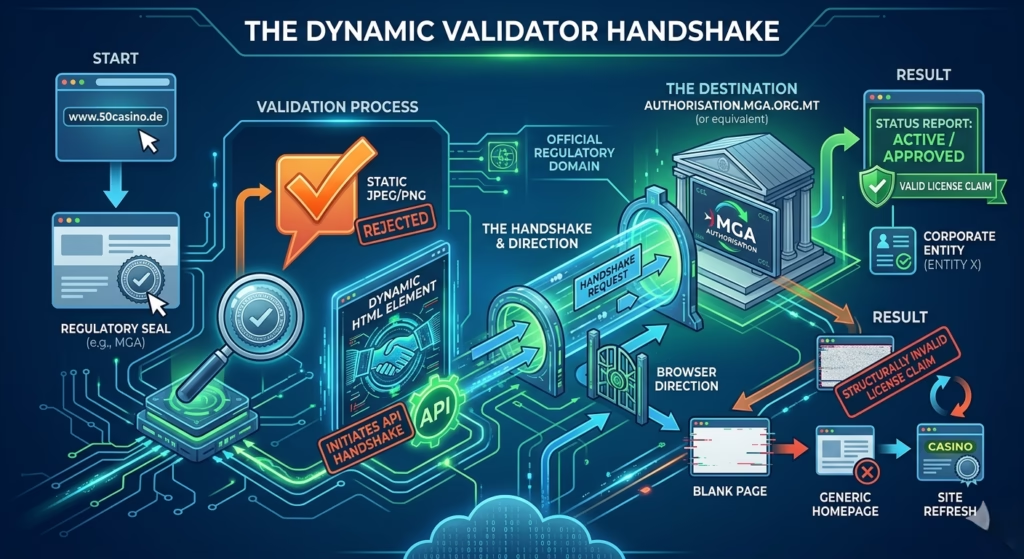
Clicking this seal should initiate an API handshake that directs your browser to the official domain of the regulatory body (e.g., authorisation.mga.org.mt or an equivalent official GGL registry). The resulting page must dynamically generate a status report confirming that the domain in question is currently “Active” or “Approved” under the specified corporate entity. If the link leads to a blank page, a generic homepage, or simply refreshes the casino site, the license claim is structurally invalid.
Jurisdictional Impact on Dispute Resolution
The true value of a regulatory framework becomes apparent only when the operational relationship breaks down. If an operator refuses a legitimate withdrawal, closes an account arbitrarily, or applies predatory terms to a balance, your path to recourse is dictated entirely by the license.
Understanding the lizenz www.50casino.de means understanding your arbitration options. High-tier regulators mandate the use of an Alternative Dispute Resolution (ADR) entity.
This table compares the structural arbitration realities players face under different global regulatory frameworks.
| Regulatory Body | ADR Requirement | Legal Recourse for Player | Operator Accountability |
|---|---|---|---|
| GGL (Germany) | Mandatory | High (Direct state intervention) | Severe (Fines, IP blocking) |
| MGA (Malta) | Mandatory (eCOGRA, etc.) | High (Binding arbitration) | High (License suspension) |
| UKGC (UK) | Mandatory | High (IBAS mediation) | Severe (Public fines) |
| Curacao (Various) | Voluntary / Varies | Low (Minimal mediation) | Low (Rarely face suspension) |
If the platform operates under a weak jurisdictional framework, the player must accept that dispute resolution will be handled internally by the casino’s own support team, which presents an inherent conflict of interest. A robust license guarantees that a neutral, legally empowered third party can intervene and force the release of funds
Player Fund Segregation and Financial Safety
Beyond dispute resolution, the regulatory architecture dictates the physical location of player capital. When conducting a rigorous Auszahlungssicherheit Test, analysts look for the enforcement of player fund segregation.
Under stringent frameworks like the MGA or GGL, an operator is legally forbidden from mixing player deposits with operational capital. If the casino files for bankruptcy, fails to pay its server hosting fees, or faces corporate liquidation, the player’s bankroll must be isolated in an independent, ring-fenced banking institution. If the lizenz www.50casino.de points to a jurisdiction that does not mandate this segregation, depositing funds represents an unsecured risk against the company’s daily operational solvency.
AML Directives and KYC Bottlenecks
The friction players often experience during the withdrawal process is directly tied to the platform’s regulatory obligations. Many negative reviews online stem from a fundamental misunderstanding of Anti-Money Laundering (AML) directives.
Before capital can legally leave the platform, the compliance department must execute Know Your Customer (KYC) protocols. They are legally required to verify that the individual requesting the withdrawal exactly matches the individual who deposited the funds, and that the funds have been subjected to a minimum turnover requirement (usually 1x) to prevent money laundering through the cashier system. A legitimate license forces the operator to delay your payout until this cryptographic and documentary verification is complete.
Structural Harm Reduction Protocols
A modern, authoritative assessment must address the infrastructure built to protect the user from mathematical variance. We do not evaluate platforms based on generic advice; we require hardcoded UI limitations.
A compliant operator will have explicit Spielerschutz Richtlinien integrated directly into the account dashboard. This is not optional under modern European frameworks. The platform must offer user-actuated loss limits, session timeouts, and deposit caps that take effect immediately upon execution, with any request to loosen these limits subject to a mandatory, unavoidable 24-hour cooling-off period.
[External Link Placeholder: GamCare or BeGambleAware technical integration standards | anchor: “industry-standard harm reduction UI guidelines” | Purpose: Responsible gambling architectural reference]
If a platform requires you to contact customer support via email to initiate a self-exclusion, rather than providing an automated API trigger within the interface, it fails the structural safety test. The UI must provide immediate, frictionless agency to the user to halt gameplay. Accessing these is a tactical necessity for managing bankroll exposure.
Integration with National Databases (OASIS / LUGAS)
If the lizenz www.50casino.de analysis reveals integration with the German market, the structural requirements escalate significantly. The GlüStV (State Treaty on Gambling) mandates that the operator’s backend constantly communicates with federal databases.
The platform must ping the OASIS system (the national player barring database) during every login attempt. Simultaneously, the cashier architecture must integrate with LUGAS to enforce a strict €1,000 monthly cross-platform deposit limit. If these API handshakes are missing, or if the operator actively advertises ways to bypass OASIS, they are operating illegally within that jurisdiction. This drastically increases the risk of fund confiscation by authorities.
Final Compliance Evaluation
Conducting an audit of the lizenz www.50casino.de requires abandoning the mindset of a consumer and adopting the methodology of a compliance officer. The frontend aesthetics are irrelevant; the backend data routing is everything.
You must successfully Betreibergesellschaft verifizieren to understand who holds your capital. You must actively Glücksspiellizenz prüfen by clicking the dynamic validator and reading the official registry entry. Do not rely on marketing claims; run an Auszahlungssicherheit Test by reviewing the specific AML and segregation clauses in the Terms and Conditions.
Ultimately, reading through subjective 50casino Erfahrungen on public forums will only provide anecdotal data. Your safety is dictated entirely by the math model, the API integrations with state databases, and the hardcoded Spielerschutz Richtlinien mandated by the issuing authority. Operating in the online gaming space requires recognizing that the house always holds a mathematical advantage; ensuring that this advantage is legally regulated and audited is the only way to mitigate existential risk to your bankroll.