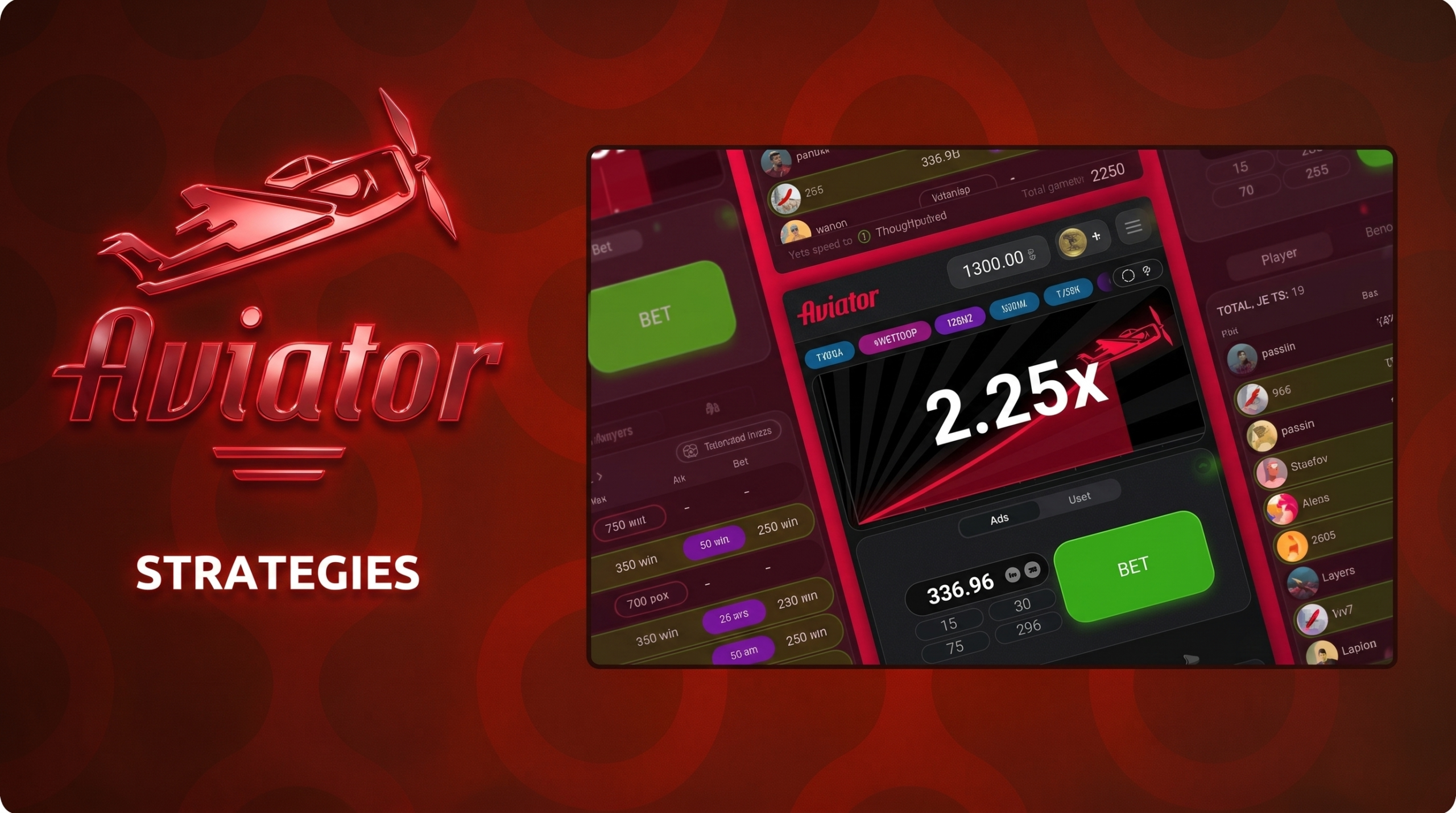
Aviator is a social multiplayer crash game where a multiplier rises until the round ends at a random point. That simple format is why the search for Aviator strategy 2026 keeps growing: players want to know whether any approach can beat the game. The honest answer is that no strategy can remove the house edge or predict the next crash. What you can do is use disciplined risk management so your play stays controlled, deliberate, and easier to budget.
If you are looking for a “system” that guarantees profit, stop there. Games like Aviator are built on chance, not patterns you can reliably exploit. The useful question is not “How do I win every round?” but “How do I manage risk, protect my bankroll, and avoid common mistakes?” That is where practical guidance can help.
 The Reality of Aviator Strategies in 2026
Aviator strategy 2026 an RNG-based game, which means each round is determined by a random number generator and does not depend on the previous round. A crash at 1.20x does not make a 10x round more likely next, and a long streak of low crashes does not create a hidden pattern. Each round is independent.
That is the most important fact for any player in 2026. Software that claims it can “read,” “predict,” or “decode” the next multiplier is not offering a real edge. In practice, those tools are either scams, misleading marketing, or unsafe software that may put your account and personal data at risk.
The only defensible way to think about Aviator strategy is as risk control. You can choose how much to bet, when to cash out, and when to stop. You cannot choose the next outcome.
How ‘Provably Fair’ Technology Works
Aviator is associated with Spribe, the game developer, and the game uses a provably fair system to support transparency. In simple terms, the outcome is created using a combination of a server seed, client seed, and other verification elements described in the game’s technical rules. This setup helps ensure the casino cannot change a specific round in real time after bets are placed.
For the player, provably fair does not mean “winnable” or “predictable.” It means the result can be checked for fairness after the round, using the published verification process. That is valuable because it improves trust, but it does not reduce the house edge or change the random nature of the game.
If you play Aviator, check the game’s own fairness documentation and the casino’s license information. Licensed operators and official game rules matter more than any Aviator strategy 2026 video or bot advertisement.
Mathematical Foundations: RTP and House Edge
The core math behind Aviator strategy 2026 is simple: the game has an expected return to player, often listed around 97% for many crash-game setups, which implies a house edge of about 3%. That does not mean every player loses 3% per session. It means that over a very large number of rounds, the casino has a built-in advantage.
RTP and house edge are the reason betting patterns do not create an advantage. A higher cashout target may increase the size of a win, but it also increases the chance of losing the entire bet. A lower cashout target may produce smaller, more frequent wins, but it still sits inside the same long-term math.
Here is a simple comparison of how crash-game math differs from traditional slot-style thinking:
| Game Metric | Meaning | Impact on Player |
|---|---|---|
| RTP | The long-term percentage of wagered money the game is designed to return | Shows the game’s overall generosity, but not any single-session result |
| House Edge | The casino’s built-in advantage over time | Explains why no betting pattern can guarantee profit |
| Volatility | How swingy the results can be from round to round | Determines how quickly your balance may rise or fall |
| Independent Rounds | Each round is separate from the last | Past crashes do not make future crashes more or less likely |
For context, many standard slot machines also run on RTP models, often in a similar broad range depending on the title and jurisdiction. The difference is not that Aviator “breaks the math.” The difference is that crash games let the player choose when to cash out, which changes the risk profile, not the underlying edge.
Practical Bankroll Management
If you want a useful Aviator strategy in 2026, focus on bankroll management, not prediction. Good bankroll management will not make the game beatable, but it can help you last longer and avoid emotional decisions.
A practical plan starts before you place your first bet. Decide how much you can afford to lose in the session. Then split that amount into smaller wagers so one bad run does not end your play immediately. This is not a winning system. It is a way to limit damage.
Strong defensive play usually includes a fixed win target and a fixed loss limit. If you reach either one, stop. That keeps you from sliding into impulse betting when the round starts moving against you.
| Strategy Concept | Objective | Risk Level |
|---|---|---|
| Fixed session bankroll | Set a hard amount to use for the full session | Lower |
| Small unit bets | Reduce the impact of a single loss | Lower |
| Win limit | Lock in profit or stop while ahead | Medium |
| Loss limit | Prevent chasing losses beyond your budget | Lower |
| Auto cashout at a modest multiplier | Control emotion and reduce decision errors | Medium |
Notice that none of these methods changes the odds. They only shape how much you risk per round and how you respond to variance. That is the honest role of strategy in a crash game.
Helpful Interactive Tool: Risk vs. Multiplier Visualization
A simple way to understandAviator strategy 2026 is to compare early cashout and late cashout choices. The earlier you cash out, the lower your potential payout, but the lower your risk of losing the bet. The longer you stay in, the higher the possible multiplier, but the greater the chance the round ends before you exit.
Crash Game Risk vs. Reward Visual. Create a simple HTML/CSS bar chart or slider that shows how the probability of the plane crashing increases as the multiplier target rises. The chart can start with a low-risk cashout target and move toward higher targets, visually showing that the likelihood of surviving the round generally drops as the target multiplier increases. This is a probability illustration only.
Safety note: This visualization illustrates mathematical probability. It does not guarantee outcomes.
A useful layout would show three zones:
- Early cashout — smaller gain, lower risk
- Mid-range cashout — balanced risk and reward
- Late cashout — larger gain potential, much higher chance of losing the round before cashout
That kind of visual helps beginners understand why “just wait longer” is not a Aviator strategy 2026 It is a risk decision. And in crash games, risk and reward always move together.
Common Mistakes and How to Avoid Them
Most losses inAviator strategy 2026 do not come from a bad “system.” They come from emotional mistakes. If you avoid these three traps, you improve your chances of making calmer decisions and protecting your bankroll.
- Chasing losses: After a losing round, increasing bets to win back money usually leads to even bigger losses. Set a limit before you start and respect it.
- Increasing bets after a crash: A recent low multiplier does not mean the next round is “due” for a high one. Each round is independent.
- Believing in prediction bots: Bots and predictor tools claiming to know the next multiplier are not trustworthy. Avoid downloading unknown software or paying for fake “signals.”
One common mistake deserves extra attention: using progressive betting ideas, such as increasing your stake after losses. In a game with a built-in house edge, that approach does not remove risk. It usually magnifies it, especially during a bad streak.
If you want a safer habit, keep your bet size consistent and use a preplanned stop point. Consistency is more useful than improvisation when the outcome is random.
 Playing Safely and Responsibly
Aviator strategy 2026 should be treated as entertainment, not income. Because the game involves financial risk, only play with money you can afford to lose. Check the operator’s license, the local age rules, and the game terms before you deposit.
It also helps to watch for signs that play is becoming a problem. These can include hiding spending, trying to recover losses immediately, borrowing money to play, losing track of time, or feeling stressed and unable to stop. If any of that sounds familiar, step away from the game.
Helpful safeguards include time limits, deposit limits, and taking regular breaks. Some licensed casinos offer self-exclusion tools and account controls. Use them if you need them.
The main point is simple: the house always has a mathematical advantage over time. That does not make the game unfair, but it does mean you should never treat strategy as a way to beat the odds permanently. Use strategy to control risk, not to chase a promise of profit.
If you or someone you know is struggling with gambling, look for support through local responsible gambling organizations, national helplines, or licensed counseling services in your region.
FAQ
Is there a 100% winning Aviator strategy 2026?
No.Aviator strategy 2026 is a game of chance, and each round is independent. No strategy can guarantee a win or remove the house edge.
What is the house edge in the Aviator game?
The house edge is typically around 3% when the RTP is about 97%. That means the casino has a long-term mathematical advantage over time.
Can I use a bot or predictor to win Aviator?
No trustworthy bot or predictor can know the next random crash point. Many such tools are scams or unsafe downloads, so avoid them.
What does ‘Provably Fair’ mean for the player?
Provably fair means the round outcome can be verified after the fact using published game data, such as seeds and hashes. It supports transparency, but it does not let you predict results.
How does the game end?
The game ends when the multiplier randomly crashes. If you have not cashed out before that point, the round is lost for that bet.