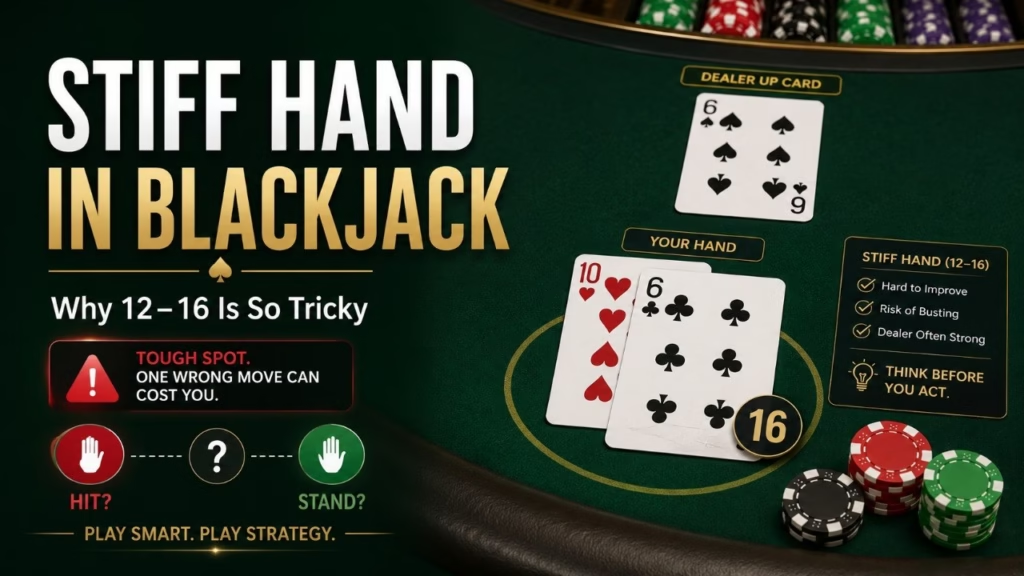
If you’ve ever asked what is a stiff in blackjack, the short answer is this: it’s a hard hand total from 12 through 16, and it puts you in an uncomfortable spot because one more card can easily bust you. That’s why players often feel tense, stuck, or frustrated when they’re holding a 15 or 16. You are usually close enough to hope, but not close enough to relax.
The tricky part is that a stiff hand is not just a “bad” hand. It is a mathematically awkward hand. Sometimes the right move is to hit, even though busting feels terrible. Other times the right move is to stand and hope the dealer breaks first. The best decision depends on the dealer’s upcard and on whether your total is a hard hand or a soft hand.
What Does a Stiff Hand Mean in Blackjack?
 A stiff hand in blackjack usually means a hard total of 12, 13, 14, 15, or 16. “Hard” means there is no Ace in the hand counted as 11. For example, 10+6 is a hard 16, while Ace+5 is a soft 16. Those two hands look similar, but they are played very differently.
The reason these hands are called stiff is simple: if you hit them, there is a strong chance the next card pushes you over 21. At the same time, if you stand, your total is often too low to win unless the dealer busts or makes a weaker hand. That puts you in a narrow decision zone where neither option feels great.
This is one of the classic pressure points in blackjack strategy. The player wants to make the mathematically best choice, not the emotionally easiest one. That principle has been central to basic strategy since the game was studied in depth by mathematicians such as Edward Thorp and later researchers.
Why 12–16 Are the Worst Hands to Hold
Hands from 12 to 16 are often called the “bust danger zone” because they sit in an awkward middle ground. They are too weak to feel safe standing against a strong dealer card, but too fragile to hit without risk. That tension is what makes stiff hands so frustrating in real play.
If you stand too early, you may lose to any dealer total of 17 or higher. If you hit, you may bust immediately. That means your decision is not about finding a comfortable option. It is about choosing the option with the better long-term expectation.
For beginners, this is where blackjack feels unfair. You can make a perfectly reasonable move and still lose the hand. That does not mean you played it badly. It means blackjack is a probability game, not a certainty game.
The Math Behind the Bust
The biggest reason stiff hands are so dangerous is that 10-value cards are the most common outcome in a standard deck. Tens, jacks, queens, and kings all count as 10. Because there are so many of them, hitting a 12 through 16 often carries a high bust chance.
For example, if you have a hard 16, drawing a 10-value card sends you to 26 and busts immediately. Since 10-value cards appear frequently, that risk is always sitting there. The exact bust chance changes based on the number of decks and the cards already played, but the basic problem stays the same: your hand is already close to the limit.
This is why stiff hands feel so punishing. One card can turn a hand that still had a small chance into a complete loss. That emotional sting is part of the game, and it is one reason players remember 15s and 16s so vividly.
The Dealer’s Upcard: The Deciding Factor
You should never treat a stiff hand in a vacuum. The dealer’s upcard changes the correct move in a major way. A player hand of 16 can be reasonable against one dealer card and a losing trap against another.
The basic strategy idea is straightforward: if the dealer is likely to break, standing can be the better choice. If the dealer is likely to make a strong total, you may need to hit even though busting is painful. That’s the heart of stiff-hand strategy.
In standard blackjack strategy for common multi-deck games, the dealer’s weak cards are usually 2 through 6, while strong cards are 7 through Ace. The dealer’s rules matter because the dealer must keep drawing until reaching a set threshold, which creates very different outcomes depending on the upcard.
When the Dealer Shows a Weak Card (2–6)
When the dealer shows 2 through 6, the dealer is in a vulnerable spot. These upcards are more likely to lead to a bust because the dealer may be forced to draw additional cards and risk going over 21.
That is why you often stand on many stiff totals against a weak dealer card. If you already have a hard 12, 13, 14, 15, or 16, standing may give the dealer enough rope to bust on their own.
This is one of the most important beginner lessons in blackjack: sometimes the best play is to let the dealer make the mistake. If the dealer has a weak upcard, your stiff hand does not need to become a stronger hand. It only needs to survive long enough for the dealer to fail.
When the Dealer Shows a Strong Card (7–Ace)
When the dealer shows 7, 8, 9, 10, or Ace, the situation changes. The dealer has a much better chance of making a strong final total, so standing on a weak hand often leaves you behind. In those spots, you are frequently forced to hit, even though the risk of busting is real.
That does not mean hitting is “safe.” It means standing is usually even worse. If your hard 15 or 16 is almost certain to lose to the dealer’s likely final hand, taking one more card may be the only move that gives you a realistic chance to win.
This is the part that feels hardest emotionally. Players often think, “I already have a bad hand, so why make it worse?” But in blackjack, sometimes the correct decision is to accept short-term pain for a better mathematical chance of winning the hand.
Helpful Interactive Table: How to Play Your Stiff Hand
Use this table as a simple guide for common stiff-hand decisions in standard basic strategy for typical 6- to 8-deck blackjack games. Remember that exact strategy can change slightly depending on rules such as whether the dealer hits or stands on soft 17.
| Player Total | Dealer Shows 2–6 | Dealer Shows 7–Ace |
|---|---|---|
| 12 | Stand | Hit |
| 13 | Stand | Hit |
| 14 | Stand | Hit |
| 15 | Stand | Hit |
| 16 | Stand | Hit |
Note: This table is based on standard basic strategy. It minimizes the house edge but cannot eliminate it or guarantee a win.
One important clarification: soft totals are different. A soft 16, such as Ace+5, is not treated the same as a hard 16 like 10+6. Soft hands have more flexibility because the Ace can switch between 11 and 1. That extra flexibility changes the correct play.
Common Mistakes When Facing a Stiff Hand
Stiff hands create emotional pressure, and that pressure leads to predictable mistakes. The most common error is the fear of busting. Players see 15 or 16 and freeze, hoping to avoid disaster. But avoiding risk is not the same as making the right move.
Another mistake is copying the dealer. Some players assume the dealer’s behavior should guide their own hand, but that is not how blackjack strategy works. The dealer follows fixed rules, while the player has choices. Your decisions should be based on the odds, not on mimicking the table.
A third mistake is playing by gut feeling. Gut instinct can be useful in some games, but blackjack rewards disciplined decision-making. If the math says hit, hit. If the math says stand, stand. That does not make every outcome pleasant, but it does reduce the house edge compared with random guessing.
It also helps to avoid “result thinking.” If you hit 16 and bust, that does not automatically mean the decision was wrong. Over many hands, basic strategy is about improving your expected result, not guaranteeing the result on any one hand.
Responsible Play and the Reality of Blackjack
 Blackjack is a chance-based casino game with financial risk. Even when you use the correct basic strategy, the house still has an edge. That means perfect play improves your odds, but it does not remove the casino’s advantage or guarantee profit.
Stiff hands are not a sign that the game is broken or unfair in a hidden way. They are part of the design of blackjack. The player gets meaningful decisions, but those decisions are never risk-free. That is why staying calm and using standard strategy matters so much.
If you are playing for real money, check the local laws, the casino’s rules, and the game details before you sit down. Small rule changes can affect strategy. And if you feel yourself chasing losses or playing while upset, step away. Blackjack should stay entertaining, not stressful.
A good mindset is simple: use the correct play, manage your bankroll carefully, and accept that short-term results will swing. That is the reality of the game, and it is especially true when you are dealing with a stiff hand.
FAQ
Can I ever win with a 16?
Yes. You can win with a 16 if the dealer busts or ends with a lower total. A 16 is weak, but it is not automatically a loss.
Is it better to always hit on 12?
No. It depends on the dealer’s upcard and the type of 12 you hold. A hard 12 is often stood on against weak dealer cards like 4, 5, or 6.
Does the number of decks affect how I play a stiff hand?
Slightly, yes. Deck count can affect the exact probabilities, but standard basic strategy stays the safest baseline in most common multi-deck games.
What should I do if I’m nervous about playing stiff hands?
Practice in free-play or demo mode first. Repeating common situations helps you learn the correct hit-or-stand decision without financial pressure.
Does standing on a stiff hand guarantee a loss?
No. Standing does not guarantee a loss, but it often leaves you relying on the dealer to bust or make a weaker total. That outcome is possible, but not certain.