Being dealt a 16 in blackjack can feel frustrating because it puts you in a bad spot almost immediately. That is exactly why many beginners ask, should i hit on 16 blackjack or stand and hope the dealer breaks? The honest answer is that there is no one-size-fits-all move. Your best decision depends on the dealer’s visible card, and the goal is not to force a win. The goal is to make the choice that loses the least over time.
That may sound disappointing, but it is the right mindset. Blackjack is a game of probability, not gut feeling. A hard 16 is one of the most awkward totals in the game because you are close enough to bust, but usually too far away to feel comfortable standing. The trick is to treat 16 as a math problem, not a “lucky” or “unlucky” hand.
Is Hitting on 16 a Beginner Mistake?
 For beginners, 16 is often called a “stiff” hand. That means it is a total that gives you very little room to improve. If you hit, you may bust. If you stand, the dealer may simply beat you with a stronger total. That tension is what makes 16 such a memorable hand for new players.
Many new players freeze because they focus only on the fear of busting. That fear is real, but standing can be just as dangerous when the dealer shows strength. In blackjack, a decision is not good just because it feels safer. It is good if it gives you the better long-term outcome against the dealer’s likely result.
So, is hitting on 16 a beginner mistake? Not automatically. In many spots, hitting is exactly what basic strategy recommends. The mistake is not hitting or standing by instinct alone. The mistake is ignoring the dealer’s upcard and making the same move every time.
The Math Behind the 16 in blackjack
A total of 16 is statistically awkward because it sits in the worst middle ground. If you stand, you are hoping the dealer finishes with 15 or less, or busts. But if the dealer shows a strong card, that hope becomes thin. If you hit, you improve your hand only when the next card helps you, and many cards will push you over 21.
That is the basic math tension behind 16. A hard 16 does not win often on its own, so you are usually choosing between two weak options. Seasoned players think of it as the lesser of two evils problem. You are not trying to make 16 into a great hand. You are trying to choose the move with the lower expected loss.
The dealer’s upcard matters because blackjack is played against the dealer’s final total, not against your own hand in isolation. If the dealer shows a weak card, the dealer is more likely to bust. If the dealer shows a strong card, the dealer is more likely to finish with a hand that beats your 16. That changes whether standing, hitting, or surrendering is the smartest play.
Basic strategy charts are built from probability calculations and computer simulations that compare all possible outcomes. They are not based on superstition. They are built from the standard cumulative probabilities of the game, which is why the correct play can change depending on the dealer’s upcard, the number of decks, and the table rules.
When to Hit and When to Stand (The Basic Strategy Rules)
As a general rule, the right move on a hard 16 depends on what the dealer is showing. If the dealer shows a weak upcard, standing can be acceptable because there is a better chance the dealer will bust. If the dealer shows a strong upcard, hitting is often the correct basic strategy play because standing on 16 is usually too weak to survive.
| Dealer Upcard | Action | Reasoning |
|---|---|---|
| 2 through 6 | Stand | The dealer is more likely to bust, so your 16 may be enough if you let the dealer play out the hand. |
| 7 through Ace | Hit | The dealer is showing strength, so standing on 16 usually gives you too little chance to win. |
This table is the simplest beginner version of basic strategy for a hard 16. It is a practical shortcut, but it is still based on probabilities, not hunches. Against weak dealer cards, you often let the dealer make the mistake. Against strong dealer cards, you usually need to try to improve your hand.
Why the Dealer’s Upcard is the Only Metric That Matters
Beginners sometimes focus on their own cards too much. A hard 16 made of 10-6 does not “feel” the same as 9-7 or 8-8, but for basic strategy, the dealer’s card usually matters more than the exact way you arrived at 16. The reason is simple: blackjack strategy is about the dealer’s likely final outcome.
If the dealer shows 6, the dealer has a relatively high bust chance. In that spot, standing with a weak total can be the right move because you are waiting for the dealer to fail. If the dealer shows 10 or Ace, the dealer is far more likely to make a strong hand. In that spot, sitting still with 16 is often a losing plan, so hitting becomes more attractive even though bust risk is uncomfortable.
This is why “the dealer’s probable bust” matters so much. You are not asking, “Can my hand get better?” You are asking, “What move gives me the best chance against the dealer’s likely final hand?” That shift in thinking is one of the biggest steps from beginner play to solid basic strategy.
Hard 16 vs. Soft 16 (A-5)
This distinction is crucial. A hard 16 means your hand has no Ace counted as 11. Examples include 10-6, 9-7, or 8-8. A soft 16 is usually A-5, which is very different because the Ace can count as 1 or 11. That means you cannot bust by taking one more card in the same way you can with a hard 16.
With a soft 16, hitting is much safer because the Ace gives you flexibility. You can draw a card and still stay alive if the hand improves poorly. In many rule sets, soft hands are played more aggressively because they carry less bust risk and more upside.
As a beginner rule of thumb, a soft 16 should usually be hit, and in some situations it may even be a double-down hand depending on the dealer’s upcard and the table rules. A hard 16 and a soft 16 are not the same decision, even though the total number looks identical on paper.
The “Surrender” Option: The Professional’s Choice
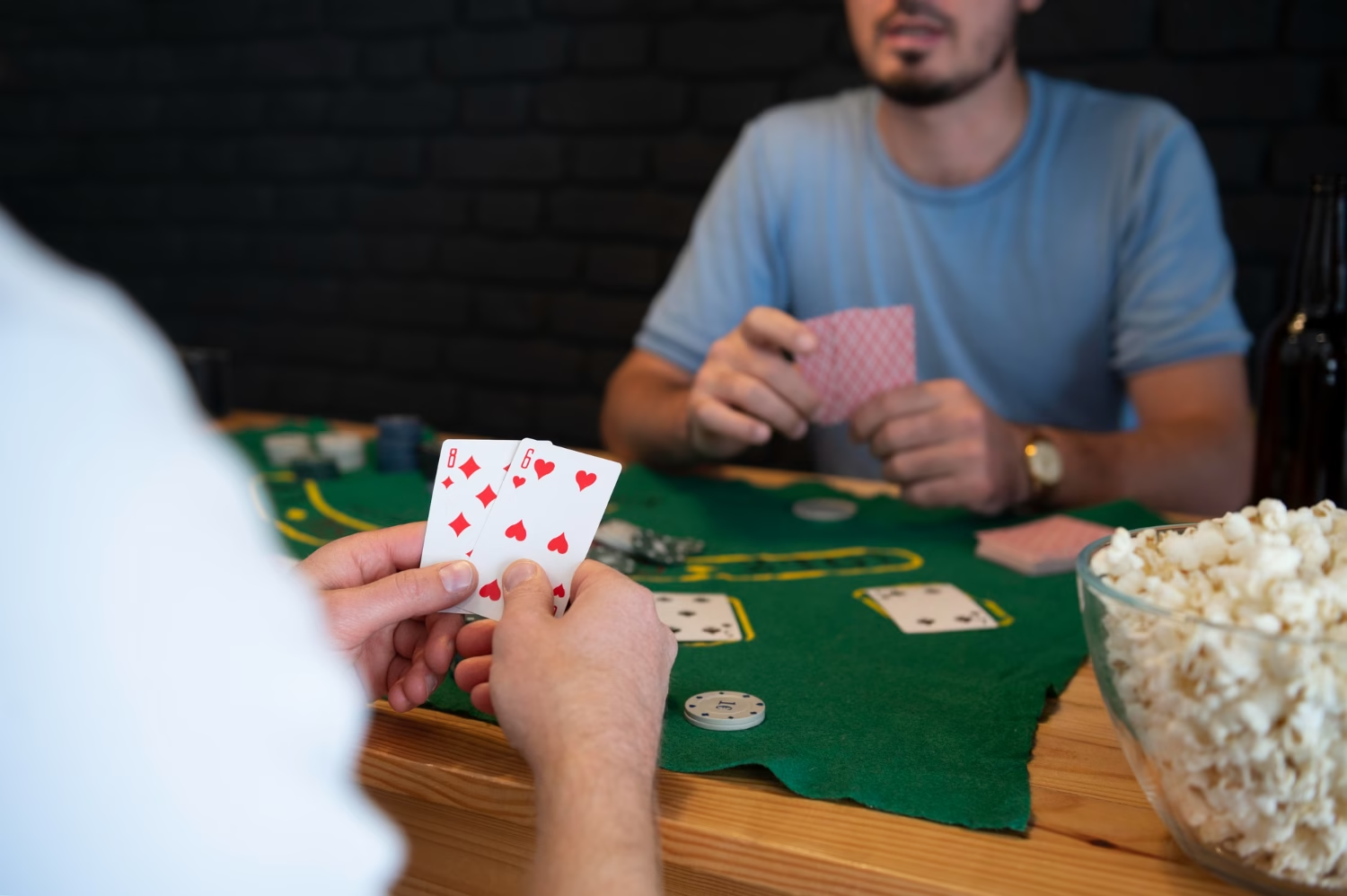 If the table offers surrender, it can be one of the smartest options on a hard 16 in the worst matchups. Late surrender lets you give up the hand after the dealer checks for blackjack, and you recover half your bet instead of playing out a very weak spot.
For many standard basic strategy charts, surrender is often preferred on a hard 16 against a dealer 9, 10, or Ace when the rule is available. That is because those dealer upcards are strong enough that hitting or standing can be especially costly over time. Surrender does not make the hand profitable, but it can reduce the damage.
Not every casino table offers surrender, and the exact rule can matter. Some tables offer late surrender, while others do not offer surrender at all. Before you sit down, check the table rules. A small rule change can slightly alter the best basic strategy move.
Remember that surrender is optional, not mandatory. If it is not available, you simply fall back to the standard hit-or-stand decision for the dealer’s upcard. That is one reason it helps to know the rules before you play.
Helpful Interactive Tool: Quick-Check Decision Box
Here is a simple, at-a-glance helper for a hard 16. It is designed for quick reference, not as a replacement for a full strategy chart. The exact best play can vary slightly with table rules, deck count, and whether surrender is offered.
| Dealer Upcard | Recommended Move on Hard 16 |
|---|---|
| 2 | Stand |
| 3 | Stand |
| 4 | Stand |
| 5 | Stand |
| 6 | Stand |
| 7 | Hit |
| 8 | Hit |
| 9 | Surrender if allowed, otherwise Hit |
| 10 | Surrender if allowed, otherwise Hit |
| Ace | Surrender if allowed, otherwise Hit |
Note: This strategy assumes standard multi-deck blackjack rules. Variations such as single-deck games, surrender rules, or whether the dealer stands on soft 17 can slightly change optimal play. Strategy reduces the house edge but does not guarantee a win. All blackjack outcomes are subject to chance.
Common Myths About “Feeling Lucky” at the Table
Blackjack players often tell themselves a story in the middle of a hand. That story can be dangerous if it replaces math. A common myth is, “The dealer will definitely bust.” Sometimes the dealer does bust, but not often enough to rely on that hope against strong upcards.
Another myth is, “My lucky number is 16.” Numbers are not lucky in blackjack. They are only totals, and totals must be judged by the board in front of you. A 16 can be a reasonable stand against a weak dealer card and a bad stand against a strong one. The number itself is not magical.
Some players also think, “I should hold because I don’t want to bust.” That feeling is natural, but it is not always the right play. If standing loses more often than hitting, the correct move may still be to take the risk. Good blackjack play is about making the less expensive mistake, not avoiding all discomfort.
The most useful habit is consistency. When you follow basic strategy, you stop making emotional decisions after every card. That does not eliminate losses, but it does protect you from turning normal variance into bigger mistakes.
Because blackjack involves gambling risk, set a budget before you play and stop when you reach it. Check the table rules, the minimum age, local laws, and the casino’s licensing information before playing. Responsible play matters more than trying to force one hand to work out.
FAQ
Does hitting on 16 make me a bad player?
No. Hitting on 16 is often the correct basic strategy play. It depends on the dealer’s upcard and the table rules, not on whether you are a beginner or an expert.
Is a Soft 16 different from a Hard 16?
Yes. A soft 16 contains an Ace counted as 11, such as A-5. That Ace gives you flexibility, so soft 16 is usually played more aggressively than hard 16.
Why does the dealer’s card matter more than mine?
Because blackjack strategy is based on the dealer’s chance of busting or making a strong total. Your best move depends on how likely the dealer is to beat your hand.
Should I always surrender on 16?
No. Surrender is only useful when the rule is available and the dealer shows a strong card, often 9, 10, or Ace. If surrender is not offered, you must choose between hitting and standing.
Does this strategy guarantee a win?
No. Basic strategy lowers the house edge, but blackjack always has a built-in house advantage. It helps you make better decisions, not perfect ones.