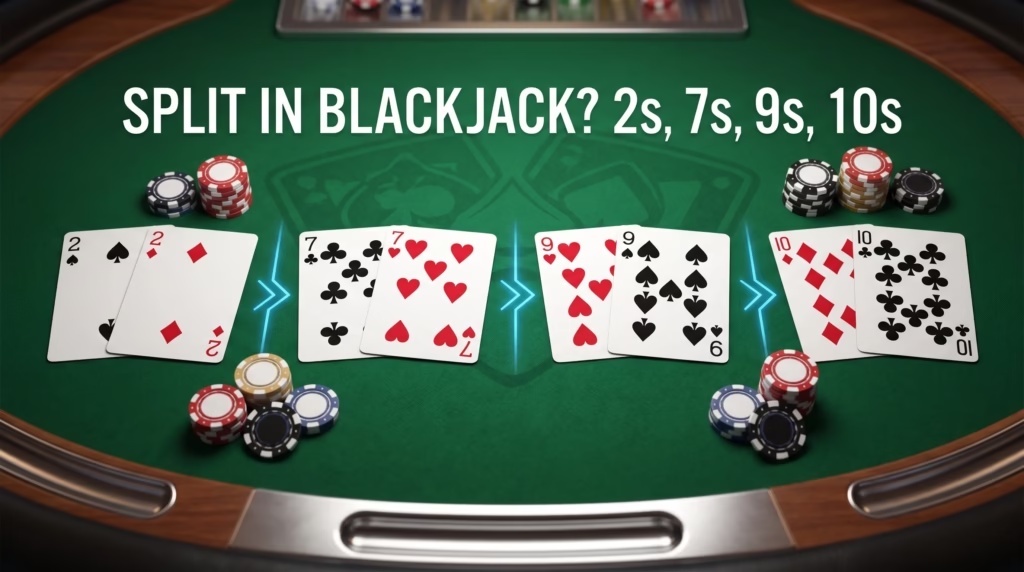
Knowing what do you split in blackjack is one of the most useful basic strategy skills you can learn. A correct split can improve your long-term results by turning a weak starting hand into two more playable hands. But splitting also means you are putting more money into action, so bankroll management matters as much as the decision itself.
The key idea is simple: you do not split because it feels lucky. You split when the math says a pair will perform better as two separate hands than as one hand. That decision depends on the pair you hold, the dealer’s up-card, and the table rules. Basic Strategy does not guarantee profit, but it does reduce the house edge when used correctly.
Understanding the Math Behind the Blackjack Split
 Splitting is not just about “getting more hands.” It is about improving the expected value of a poor or limited hand. Some pairs are awkward to play as a single total. For example, a pair of 8s gives you a hard 16, which is one of the weakest totals in blackjack. By splitting, you get two new starting hands that each have a better chance to develop into a strong total.
Basic Strategy is built from computer-modeled probabilities. It compares the long-term outcome of splitting, hitting, standing, or doubling in each common situation. The best move is the one with the highest expected return over many hands, not the move that looks best in one moment.
The dealer’s up-card matters because it shows part of the dealer’s final strength. A dealer showing 2 through 6 is usually considered weak because that range is more likely to bust. A dealer showing 7 through Ace is stronger and more likely to make a solid hand. That difference changes whether a split is worth it.
In short, splitting works when it improves your position against the dealer’s expected outcome. It is a probability decision, not a guarantee.
The Essential Blackjack Split Cheat Sheet
| Pair | Action | Condition |
|---|---|---|
| Aces | Split | Always |
| 8s | Split | Always |
| 10s | Do not split | Never split |
| 5s | Do not split | Double down if allowed; otherwise hit |
| 9s | Split | Against dealer 2–6, 8, 9; stand against 7, 10, Ace |
| 7s | Split | Against dealer 2–7 |
| 6s | Split | Against dealer 2–6 |
| 4s | Split | Against dealer 5–6 only if doubling after split is allowed |
| 3s | Split | Against dealer 2–7 |
| 2s | Split | Against dealer 2–7 |
Reference note: This table reflects standard Blackjack Basic Strategy for common 6–8 deck games where the dealer stands on soft 17. Results are based on probability; individual hands remain subject to the house edge. Some rules, such as no double after split, can change the best play in certain spots.
Helpful Interactive Tool or Visual to Add
Blackjack Split Decision Quick-Reference Table is easiest to use as a clear, high-contrast HTML table. For fast reading, keep the advice grouped into three simple actions: split, stand, or keep the hand together. This makes it easier to scan during play.
| Pair | Action | Condition |
|---|---|---|
| Aces | Split | Always |
| 8s | Split | Always |
| 10s | Stand | Never split |
| 9s | Split | Split against 2–6, 8, 9 |
| 7s | Split | Split against 2–7 |
| 6s | Split | Split against 2–6 |
| 5s | Double down | Do not split |
| 4s | Split | Only in some rulesets against 5–6 |
| 3s | Split | Split against 2–7 |
| 2s | Split | Split against 2–7 |
When You Should Always Split
Some pairs are so strong as split hands that basic strategy treats them as non-negotiable. The two clearest examples are Aces and 8s.
Aces
A pair of Aces is the strongest split in blackjack because each Ace can start a new hand with huge potential. If you keep them together, you have only a soft 12, which is not a powerful total. If you split, each Ace can receive a card that creates a strong soft hand or even a made 21.
Splitting Aces also gives you two chances to reach a winning hand instead of one weak one. That is why experienced players treat this as a must-split situation in nearly every standard game.
8s
A pair of 8s adds up to 16, and hard 16 is one of the worst totals in blackjack. Standing on 16 is usually weak, and hitting it is dangerous because many cards can bust you. Splitting 8s breaks that poor total into two hands that have far better upside.
This is not about looking for a lucky recovery. It is about avoiding a very bad starting point. Even when one or both split hands still do not become winners, the split remains the better long-term decision than playing the 16 as a single hand.
When You Should Never Split
Some pairs should stay together because the total is already valuable. Splitting them reduces their strength instead of improving it.
10s
A pair of 10s gives you a total of 20, which is already a very strong hand. Against the dealer, 20 wins often enough that breaking it apart is usually a mistake. When people ask what do you split in blackjack, 10s are one of the clearest “do not split” answers.
Splitting 10s means turning a powerful made hand into two hands that are much more uncertain. Even if the idea of two winning hands feels attractive, the math does not support it. Keeping 20 intact is the better basic strategy play.
5s
Pairing 5s gives you a total of 10, which is a great candidate for doubling down in many situations. A 10 is flexible and can improve nicely with one more card. That is why you should not split 5s.
Splitting 5s throws away one of the strongest double-down starting points in the game. If doubling after split is allowed, this hand still should not be split. The correct approach is usually to treat it as a strong 10 and follow the standard double-down rules.
Conditional Splits: It Depends on the Dealer
Most of the real strategy work in blackjack comes from conditional splits. These are hands where your decision changes based on the dealer’s up-card. The reason is simple: the dealer’s visible card tells you whether the dealer is weak or strong.
When the dealer shows 2 through 6, the dealer is more likely to bust. That makes aggressive split decisions more attractive because even a modest final hand can win. When the dealer shows 7 through Ace, the dealer is more likely to make a strong total, so you need a better hand or a more favorable split to justify the move.
2s and 3s
Split 2s and 3s against dealer 2 through 7 in standard basic strategy. These pairs are not especially strong by themselves, but splitting them gives you two chances to improve against a dealer who is not showing a strong starting card.
If the dealer shows 8, 9, 10, or Ace, the dealer’s position is stronger, so those splits lose value and are usually avoided.
4s
4s are a special case. In many standard games, you only split 4s against dealer 5 or 6, and even then only when doubling after split is allowed. The reason is that the pair of 4s is not a great standalone hand, but against a weak dealer up-card the split can create better opportunities.
If the table has restrictive rules such as no double after split, the value of splitting 4s drops even more. That is why rules checks matter.
6s
Split 6s against dealer 2 through 6. A pair of 6s makes 12, which is not strong enough to stand comfortably. Splitting gives you two hands that can each improve into something more competitive.
Against a strong dealer card, the split becomes less appealing because the dealer is more likely to make a solid hand.
7s
Split 7s against dealer 2 through 7. This is another case where the dealer’s weakness matters. A pair of 7s is already a decent starting point, but two separate hands can create more value against a dealer who is more likely to bust or finish with a mediocre total.
Against stronger dealer up-cards, keep the 7s together unless the specific house rules you are playing under suggest otherwise.
9s
9s are one of the most common conditional splits. You usually split against dealer 2 through 6, 8, and 9, but stand against dealer 7, 10, and Ace. The idea is that 18 is already solid, but it does not always outrank the dealer’s likely result.
Against weak dealer cards, splitting 9s can create two hands that are more profitable than standing on 18. Against strong dealer cards, 18 often performs better as a single hand than two split hands would.
Common Mistakes to Avoid When Splitting
One of the biggest mistakes is splitting based on emotion instead of strategy. Players sometimes split because they are bored, frustrated, or trying to “force” a win after a losing streak. That is a fast way to drift away from basic strategy and increase the cost of variance.
Another common mistake is forgetting that splitting doubles your stake. Even when the move is mathematically correct, it still increases the amount of money at risk on that hand. You should only play at stakes your bankroll can handle.
It also helps to avoid gut feelings when the chart says otherwise. Blackjack rewards discipline. If your table rules match standard basic strategy, trust the math rather than a hunch about what “should” happen.
Finally, do not assume every table uses the same split rules. Small rule changes can affect the best move, especially for hands like 4s, 5s, and 9s.
Responsible Play and House Edge Reality
 Basic Strategy is a long-term optimization tool, not a shortcut to guaranteed profit. It helps you make the statistically best decision in each common situation, which lowers the house edge compared with random play. But the house edge does not disappear.
Blackjack remains a game of chance, and short-term results can go either way. You can play perfectly and still lose a session. That is normal. The purpose of basic strategy is to improve your expected return over time, not to promise a winning outcome on any individual shoe or hand.
Before you play, check the table rules carefully. A few common variations can change optimal split decisions:
- Can you double after split?
- How many times can you resplit pairs?
- Can you split Aces more than once?
- Does the dealer stand on soft 17?
- Are there restrictions on splitting 4s, 5s, or 10s?
These details matter because they can slightly shift the math. Online and land-based blackjack often use the same basic strategy concepts, but the exact house rules can differ from table to table. Always verify the rules before placing bets.
FAQ
Does splitting always guarantee a better outcome?
No. Splitting improves your probability in certain situations, but it does not guarantee a win. Basic Strategy chooses the play with the best expected value over time.
Can I split multiple times if I get another pair?
Sometimes. House rules vary by casino and game type. Some tables allow resplitting, while others limit how many times you can split.
Why shouldn’t I split 10s when I have a 20?
Because 20 is already one of the strongest hands in blackjack. Splitting it turns a powerful made hand into two much weaker hands with lower expected value.
Is it better to hit or split 9s?
It depends on the dealer’s up-card. In standard basic strategy, you usually split 9s against dealer 2–6, 8, and 9, but stand against 7, 10, and Ace.
Are these rules the same for online and land-based blackjack?
The basic strategy logic is the same, but the table rules may differ. Online games and live tables can have different split, doubling, and resplit rules, so always check the game rules first.