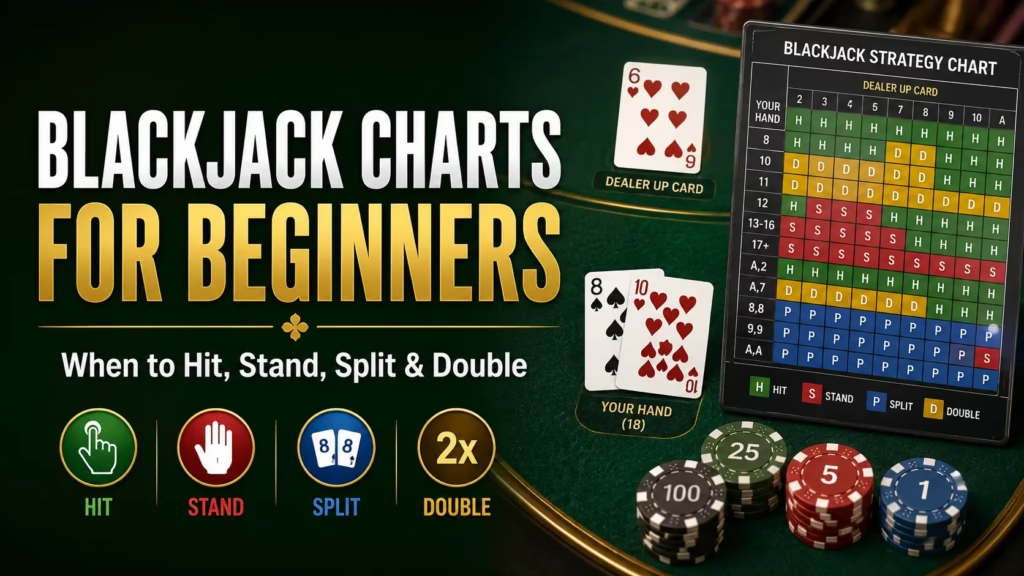
Blackjack charts show the mathematically optimal move for every possible hand combination. By following a basic strategy chart, you reduce the house edge from roughly 2% or 3% down to approximately 0.5%. This is the closest a player can get to even odds in a casino.
The logic behind blackjack basic strategy
Blackjack is a game of dependent events. Because the deck has a fixed number of cards, the cards already dealt affect the probability of the cards remaining. Basic strategy charts are the result of computer simulations that played millions of hands to determine which decision (Hit, Stand, Double, or Split) yields the highest expected value for the player.
Using a chart removes emotional decision-making. Most players lose money because they play based on a feeling or a streak. The math does not care about feelings. It only cares about the dealer’s visible card and the two cards in your hand.
How to read a blackjack chart
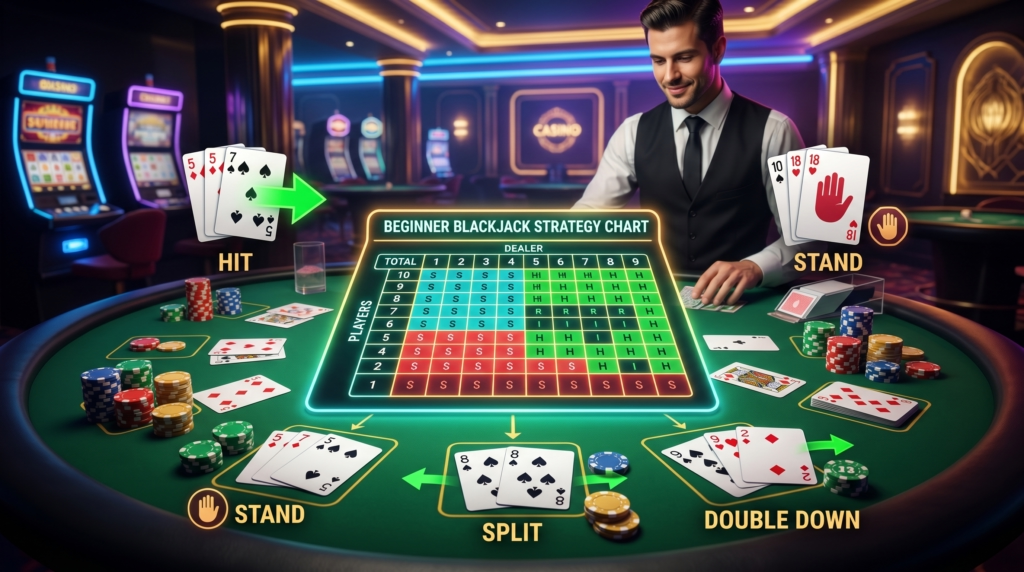
A standard blackjack chart is a grid. The top row represents the dealer’s upcard (2 through Ace). The left-hand column represents your hand total or specific card combination. To use it, find your hand on the left, move your finger across to the column under the dealer’s card, and follow the instruction in that cell.
- H: Hit (Take another card).
- S: Stand (Keep your current total).
- D: Double Down (Double your bet, take exactly one more card).
- P: Split (Separate your pair into two hands).
- Rh: Surrender if possible, otherwise Hit.
Basic strategy for hard totals
A hard hand is any hand that does not contain an Ace, or contains an Ace that must be counted as 1 to avoid busting. These hands are less flexible than soft hands because one hit can result in a loss.
| Player Hand | 2 | 3 | 4 | 5 | 6 | 7 | 8 | 9 | 10 | A |
|---|---|---|---|---|---|---|---|---|---|---|
| 8 | H | H | H | H | H | H | H | H | H | H |
| 9 | H | D | D | D | D | H | H | H | H | H |
| 10 | D | D | D | D | D | D | D | D | H | H |
| 11 | D | D | D | D | D | D | D | D | D | D |
| 12 | H | H | S | S | S | H | H | H | H | H |
| 13 | S | S | S | S | S | H | H | H | H | H |
| 14 | S | S | S | S | S | H | H | H | H | H |
| 15 | S | S | S | S | S | H | H | H | Rh | H |
| 16 | S | S | S | S | S | H | H | Rh | Rh | Rh |
| 17-21 | S | S | S | S | S | S | S | S | S | S |
Understanding the hard total strategy
The strategy for hard totals relies heavily on the dealer’s “bust cards.” In blackjack, a dealer showing a 4, 5, or 6 is in a weak position. They are statistically likely to bust. This is why you stand on low totals like 12 or 13 when the dealer shows those cards.
If the dealer shows a 7 or higher, they have a “pat hand” (a hand likely to reach 17-21). In these cases, you must be more aggressive. You hit until you reach at least 17, even if it means risking a bust. Standing on a 16 against a dealer’s 10 is a common mistake; while hitting 16 feels risky, the math shows you lose less often by hitting than by standing.
Basic strategy for soft totals
A soft hand contains an Ace that can be counted as 11 without the total exceeding 21. Soft hands give you a safety net because if you hit and go over 21, the Ace simply reverts to a value of 1.
| Player Hand | 2 | 3 | 4 | 5 | 6 | 7 | 8 | 9 | 10 | A |
|---|---|---|---|---|---|---|---|---|---|---|
| A,2 | H | H | H | D | D | H | H | H | H | H |
| A,3 | H | H | H | D | D | H | H | H | H | H |
| A,4 | H | H | D | D | D | H | H | H | H | H |
| A,5 | H | H | D | D | D | H | H | H | H | H |
| A,6 | H | D | D | D | D | H | H | H | H | H |
| A,7 | S | D | D | D | D | S | S | H | H | H |
| A,8 | S | S | S | S | S | S | S | S | S | S |
| A,9 | S | S | S | S | S | S | S | S | S | S |
The flexibility of soft hands
Soft hands allow for aggressive doubling down. For example, when you have Soft 13 through Soft 18, you should frequently double down if the dealer shows a 4, 5, or 6. You are not necessarily looking to get a high total on that one extra card; you are betting that the dealer will bust.
Soft 18 (Ace and 7) is the most misplayed hand in blackjack. Many beginners stand against everything. However, the chart shows you should double against a dealer’s 3 through 6, and hit against a 9, 10, or Ace. Standing on 18 against a dealer’s 10 is a losing play in the long run because a 10-value card or an Ace for the dealer easily beats your 18.
Basic strategy for splitting pairs
Splitting allows you to turn one potentially weak hand into two strong ones. It requires an additional bet equal to your original wager.
| Player Pair | 2 | 3 | 4 | 5 | 6 | 7 | 8 | 9 | 10 | A |
|---|---|---|---|---|---|---|---|---|---|---|
| A,A | P | P | P | P | P | P | P | P | P | P |
| 10,10 | S | S | S | S | S | S | S | S | S | S |
| 9,9 | P | P | P | P | P | S | P | P | S | S |
| 8,8 | P | P | P | P | P | P | P | P | P | P |
| 7,7 | P | P | P | P | P | P | H | H | H | H |
| 6,6 | P | P | P | P | P | H | H | H | H | H |
| 5,5 | D | D | D | D | D | D | D | D | H | H |
| 4,4 | H | H | H | P | P | H | H | H | H | H |
| 3,3 | P | P | P | P | P | P | H | H | H | H |
| 2,2 | P | P | P | P | P | P | H | H | H | H |
Critical splitting rules to remember
There are two rules you must never break: always split Aces and 8s, and never split 10s or 5s.
Two Aces give you a total of 12 (soft) or 2. By splitting them, you have two chances to hit a 21. Conversely, a pair of 8s makes 16, which is the worst possible hand in blackjack. Splitting them gives you two hands starting with 8, which is a much stronger statistical foundation than a single 16.
Never split 10s because 20 is already a winning hand. Risking a 20 to try for two higher hands is mathematically poor. Never split 5s because a pair of 5s is a hard 10. You are better off doubling down on a 10 than playing two hands starting with 5.
How rule variations change the chart
Not all blackjack games use the same rules. These variations can slightly alter the optimal strategy.
Dealer hits or stands on soft 17
In many casinos, the dealer must hit on a Soft 17 (H17). This increases the house edge by about 0.2%. If the dealer hits Soft 17, you should be slightly more aggressive with doubling down. Specifically, you would double down on 11 against a dealer’s Ace, and double down on Soft 19 (A,8) against a dealer’s 6.
Number of decks in play
Single-deck blackjack offers the lowest house edge but is rare. Most modern casinos use 6 or 8 decks in a shoe. As more decks are added, the likelihood of drawing a specific card changes slightly. In single-deck games, you should double down on an 8 against a dealer’s 5 or 6, whereas in multi-deck games, you simply hit an 8.
Surrender options
Late surrender allows you to give up your hand and half your bet after the dealer checks for blackjack. This is a powerful tool for reducing losses. You should typically surrender a Hard 16 against a dealer’s 9, 10, or Ace, and a Hard 15 against a dealer’s 10.
Why beginners fail to use charts correctly
The biggest obstacle to using a blackjack chart is the “hunches.” A player might see a dealer showing a 2 and feel they should stand on a 12 because they are afraid of busting. The chart says to hit. The player hits, busts, and then blames the chart. They fail to realize that standing on 12 against a 2 loses more money over 1,000 hands than hitting does.
Consistency is the only way to realize the benefits of basic strategy. Deviating from the chart based on the previous hand’s result or a “gut feeling” increases the house edge immediately. The math only works over long periods. In a single session, anything can happen. Over a year of play, the player who follows the chart will always have more money than the player who does not.
Common blackjack chart mistakes
- Over-valuing 18: Thinking 18 is a “safe” hand and failing to hit or double when the chart demands it.
- Fear of busting: Standing on 12-16 when the dealer shows a high card.
- Mismanaging 4s: Splitting 4s against a dealer 5 or 6 only if “Double After Split” (DAS) is allowed. If DAS is not allowed, you should just hit.
- Chasing losses: Increasing bet sizes while ignoring strategy because of a losing streak.
FAQs about blackjack charts
Can I bring a blackjack chart to the casino?
Yes. Most casinos allow you to hold a small strategy card at the table. As long as you do not slow down the game or place the card on the felt (which can interfere with cameras and chip placement), dealers generally do not mind. Some casino gift shops even sell them.
Is basic strategy different for online blackjack?
The strategy remains the same as long as the rules (decks, H17/S17, etc.) are identical. Most online blackjack games use 6 or 8 decks and have the dealer hit on soft 17, so use a standard multi-deck H17 chart.
Does a blackjack chart guarantee that I will win?
No. Blackjack charts are designed to minimize the house edge, not eliminate it. Even with perfect play, the casino maintains a 0.5% advantage. The chart helps you lose less over time and gives you the best chance of a winning session.
Should I always split 10s if the dealer is showing a 6?
No. You should never split 10s. A total of 20 is a winning hand in the vast majority of cases. Breaking it up to risk getting two weaker hands is a major mathematical error that increases the house edge.
What is the difference between a hard hand and a soft hand?
A soft hand contains an Ace that counts as 11, meaning you cannot bust with one more card. A hard hand either has no Ace or an Ace that must count as 1 to avoid going over 21.