Crash games have become popular because they feel fast, simple, and unpredictable. A multiplier climbs, players cash out when they want, and the round can end at any moment. That is also why many players look for patterns in crash game odds and assume there must be a way to see when the next crash will happen.
The reality is more technical and less magical. Crash game outcomes are built from random-number generation, seeds, hashing, and a built-in house edge. Understanding those pieces helps explain why the game feels random, why results cannot be predicted in real time, and why short winning streaks do not change the math behind the next round.
This guide breaks down the mechanics in plain language. It also explains what “provably fair” means, why RTP is an average rather than a promise, and why no calculation removes the house edge. If you play crash games, check the game rules, the provider’s documentation, and the operator’s license before risking money.
The Mechanics Behind Crash Game Multipliers
 Understanding Odds vs. House Edge
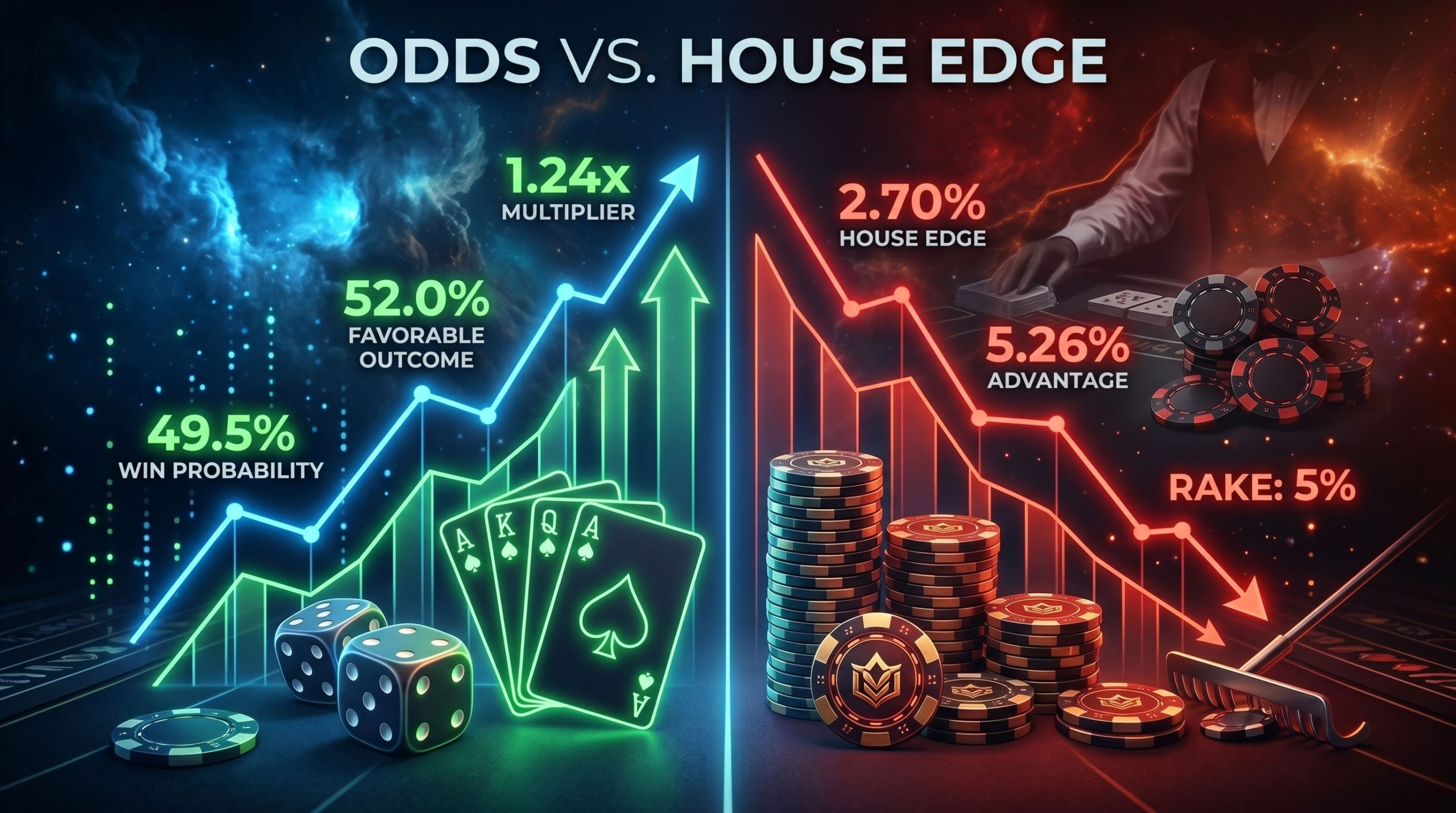
Crash game odds are often misunderstood because players focus on the rising multiplier instead of the underlying probability curve. The higher the multiplier goes, the less likely the round is to keep going. That is why low multipliers are more common than very high ones.
Every crash game also has a built-in house edge. The house edge is the mathematical advantage the operator keeps over time. It does not mean every round is unfair or manipulated. It means the game is designed so the casino has a long-term edge across many bets.
Most popular crash games advertise RTP figures in the rough range of 95% to 97%, depending on the title, provider, and operator settings. RTP means return to player. It describes the theoretical average paid back over a very large number of rounds. It does not mean you should expect 95% or 97% back in one session.
As the multiplier rises, the chance of reaching that level falls. The table below shows a simplified view of how risk increases. The exact probability varies by game and provider, so treat this as a general explanation rather than live game data.
| Multiplier Level | Theoretical Probability | Risk Category | Player Impact |
|---|---|---|---|
| 1.2x | High likelihood | Low | Frequent small exits, lower payout size |
| 2.0x | Moderate likelihood | Medium | Balance between safety and return |
| 5.0x | Much lower likelihood | High | Fewer wins, larger swings |
| 10x+ | Rare | Very high | Large upside, but many rounds end before this level |
What this means in practice is simple: the game is built to pay smaller multipliers more often and larger multipliers less often. A house edge of even a few percent slowly shifts the expected value away from the player over time.
How Provably Fair Systems Work
A provably fair system lets players verify that a round was not altered after the fact. This is one reason crash game odds are trusted by players who want more transparency than a closed, unverified random system.
Here is the basic idea. Before the round, the game publishes a hash of the server seed. After the round, the server seed is revealed. Players can compare the revealed seed with the earlier hash to confirm that the result matches what was committed to before play began.
In some systems, the client seed and a nonce, which is a round counter, are also included in the calculation. A nonce helps keep each round distinct even if other values repeat. This prevents the same inputs from producing the same visible result over and over.
Provably fair does not mean profitable. It means the game outcome can be checked for integrity. It does not remove the house edge, and it does not improve a player’s expected return. A fair game can still be a losing game over time, regardless of the displayed crash game odds.
If you want to verify a specific crash game, check the provider’s official documentation and the game’s fairness page. Established studios such as Spribe and Pragmatic Play usually publish rules or technical notes that explain how their systems are built. The exact verification method can differ by studio, so it is worth reading the current documentation rather than relying on forum advice.
Also check whether the operator holds a valid license in your jurisdiction. A provably fair certificate is helpful, but it should sit alongside proper regulation, clear terms, and responsible gambling tools.
Why Your Winning Chances Can’t Be Calculated in Real-Time
Each crash round is an independent event. That means the result of the last round does not force the next round to be higher or lower. A sequence of low crashes does not make a big crash “due.” This is a common mistake called the Gambler’s Fallacy.
The Gambler’s Fallacy happens when people assume short-term streaks change the odds of the next random event. In crash games, that is not how the math works. The next multiplier is based on the game’s RNG and seed process, not on a memory of the previous round.
That is why no live watching pattern can give you a real-time formula for the next crash. A streak of 1.2x, 1.1x, and 1.4x results may feel like a high multiplier is coming, but the next round still has its own independent probability curve.
There is also a practical reason players should be cautious. Fast rounds create the illusion of control. When a game moves quickly, people tend to overread small samples and treat coincidence as a signal. In reality, short-run variance is normal.
When people ask whether crash game odds can be calculated in real time, the honest answer is no. You can estimate the long-term model, but you cannot reliably predict the next crash point from in-session history.
Helpful Interactive Tool: Visualizing House Edge
The simulation below is a simple educational visual. It shows how changing the house edge affects the balance between outcomes that appear to reach a break-even zone and outcomes that fall below it. This is a mathematical simulation only. It does not represent live game data.
| House Edge | Below Break-Even | Above Break-Even |
|---|---|---|
| 1% | ███████████░░░░░░░░░ | █████████████░░░░░░ |
| 3% | █████████████░░░░░░░ | ███████████░░░░░░░░░ |
| 5% | ███████████████░░░░░ | █████████░░░░░░░░░░░ |
How to read this: as the house edge rises, more outcomes sit below the point where a player would need to break even. That does not mean every round loses, but it does mean the long-term math becomes less favorable.
If your WordPress setup uses an interactive slider, the player could adjust the house edge percentage and see the two columns change in real time. The purpose is educational, not predictive. It should never be treated as a way to forecast the next round.
Common Misconceptions About Crash Game Odds
One of the biggest myths is that you can “read” the chart and spot a pattern. Crash games may show streaks that look meaningful, but streaks happen in random systems all the time. Human brains are very good at finding patterns, even when none exist.
Another myth is that a bot or script can predict the next crash. A tool may track results, but it cannot change the underlying RNG or expose the next seed before the game reveals it. If a product claims it can reliably predict crash outcomes, treat that claim with extreme skepticism.
Some players also believe that cashing out at a certain multiplier can beat the house in a stable way. In reality, the cash-out point changes your risk profile, not the house edge. Lower targets may win more often, but they usually pay less when they do. Higher targets pay more when they hit, but they hit less often.
Another misconception is that “provably fair” means the game is safe to play without caution. It does not. It only means the round can be checked for tampering. You can still lose money quickly in a provably fair game if you play without limits.
Responsible Gambling in Fast-Paced Games
Crash games are fast, and fast games can be risky. Because rounds end quickly, it is easy to chase losses, overbet, or keep playing longer than planned. That can happen even when the game is technically fair, which is important to remember when looking at overall crash game odds.
Before you play, set a session budget and a hard stop time. Treat both as fixed. If you reach your limit, stop. Do not increase your stake to recover previous losses, and do not assume the next round will compensate for earlier results.
It also helps to choose games from licensed operators and to review the rules before placing any money. Check the minimum and maximum bet, auto cash-out settings, RTP information, and whether the game provider publishes a fairness page. If anything is unclear, look for the official rules rather than relying on social media advice.
Remember that gambling involves financial risk. No calculation, no pattern check, and no “system” can remove the house edge from crash game odds. If play stops feeling fun or starts affecting your budget, use responsible gambling tools or step away entirely.
FAQ
What is a crash game multiplier?
A crash game multiplier is the number that increases during a round and shows how much a bet would be worth if the player cashes out before the crash point.
Are crash games rigged?
Not necessarily. Legitimate crash games use RNG and provably fair systems, but players should still verify the game provider, operator license, and fairness documentation. A fair game can still have a house edge.
Can I calculate when the game will crash?
No. You can understand the long-term mathematics, but you cannot reliably calculate the exact crash point for the next round in real time.
What does “Provably Fair” mean for the player?
It means the player can verify that the round outcome was generated honestly and was not changed after the fact. It does not mean the player is expected to profit.
Is there a strategy to win every time in crash games?
No. There is no strategy that wins every time in crash games because the house edge remains in place and each round is independent.
What is the house edge in most crash games?
The house edge varies by game and operator, but many crash games effectively sit in the low single digits, with RTP often around 95% to 97%. Always check the official game rules for the current figure.