
More About Crypto Casinos vs Traditional Casinos
I remember when depositing money at an online casino meant typing in a credit card number and hoping nothing weird happened on your bank statement later. It felt… slightly sketchy, even on reputable platforms. Withdrawals sometimes took days. Sometimes longer. And players just accepted that as part of the experience.
Then crypto walked into the room and changed the conversation.
Suddenly deposits happened in minutes. Sometimes seconds. No bank approvals. No payment processors asking awkward questions about “international gaming transactions.”
I’ve noticed lately that players aren’t just debating games anymore. They’re debating infrastructure. How money moves. Who controls it. And whether casinos should even touch your banking information at all.
That’s where the debate between crypto casinos and traditional casinos really begins.
It’s not just about currency. It’s about trust, speed, transparency, and control. And like most things in gambling, the answer isn’t as simple as “new is better.”
Let’s break it down.
The Old System: How Traditional Online Casinos Work
Traditional online casinos follow a structure that’s been around for decades. You create an account, verify your identity, connect a payment method, and start playing.
Most transactions run through payment processors or banks. That means deposits and withdrawals are routed through several layers of financial infrastructure.
I remember waiting three days for my first withdrawal years ago. At the time it felt normal. Today? That kind of delay feels prehistoric.
But traditional casinos still dominate the industry for one big reason: regulation.
Licensed operators must follow strict rules regarding identity checks, payment monitoring, and anti-money laundering compliance. This process can be frustrating when you’re just trying to cash out winnings, but it also creates a controlled environment that many players trust.
And let’s be honest—some players actually prefer that structure.
The Vibe Check
Mood: Structured and regulated.
Summary: Traditional casinos rely on established banking systems and heavy regulation to maintain credibility.
The Crypto Casino Revolution
Now let’s talk about the disruptor.
Crypto casinos flipped the traditional model by removing banks from the equation entirely. Players deposit using cryptocurrencies like Bitcoin, Ethereum, or other digital assets.
Transactions occur directly on the blockchain.
I’ve noticed that many players initially approach crypto casinos because of convenience. But they stay because of privacy and speed.
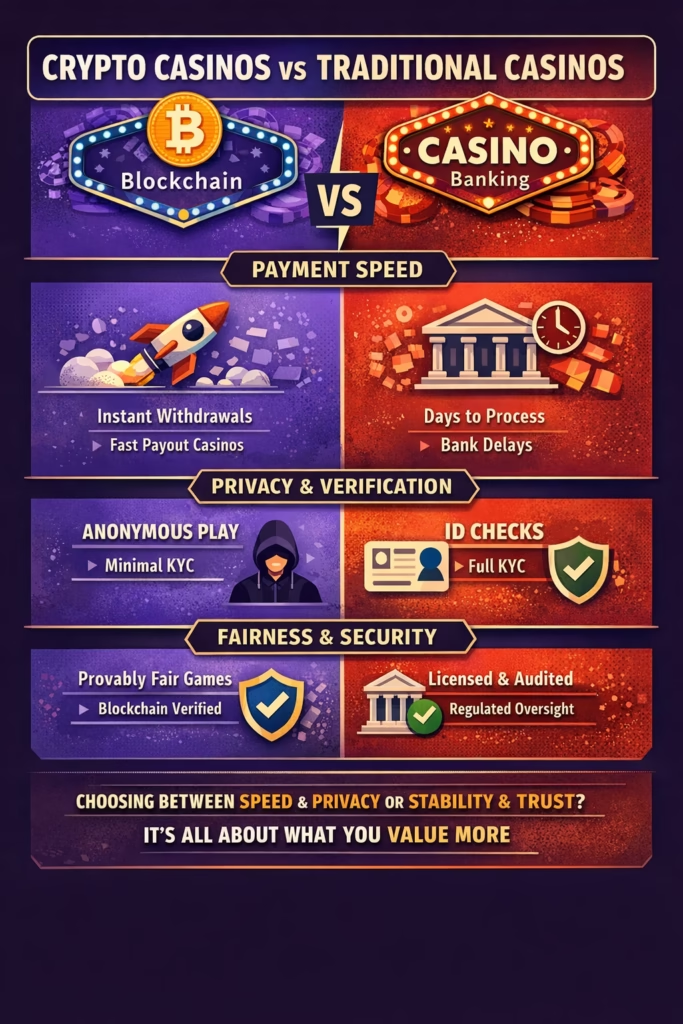
Withdrawals that once took days now take minutes. Some platforms built their entire reputation around being part of the fast payout casinos category. In other words, your money moves almost as quickly as the games themselves.
Actually, scratch that—it’s not just speed. It’s independence.
Crypto payments eliminate many of the restrictions that traditional banking systems impose on gambling transactions.
Hot Take
Traditional banking and online gambling were never a perfect match. Crypto simply removed the middleman
Transparency and Provably Fair Gaming
One of the biggest talking points in crypto casinos is transparency.
Traditional casinos rely on third-party auditing to prove their games are legitimate. Regulators test the software and certify that the random number generators behave properly.
Crypto platforms often take a different approach.
Instead of trusting a regulator, players can verify outcomes using blockchain-based verification systems. These systems are commonly associated with fair play gaming, where each game round can be mathematically validated after it occurs.
I remember checking one of these verification tools for the first time. It looked complicated. Hash values, seed numbers, cryptographic formulas.
But once you understand it, the concept is pretty simple.
The casino can’t secretly manipulate a result without breaking the verification system. That level of transparency appeals to players who don’t want to rely solely on licensing authorities.
Pro-Tip
If you’re curious about provably fair systems, try verifying a few game rounds manually. It takes a few minutes to understand, but once you get it, the process becomes surprisingly reassuring.
Game Libraries: Old School vs New Wave
Game selection is another area where differences appear.
Traditional casinos often focus on classic titles—roulette, blackjack, poker, and thousands of slot variations. Many of these come from well-known software providers with years of reputation behind them.
Crypto casinos, on the other hand, tend to experiment more.
I’ve noticed that crash games, instant games, and blockchain-based mechanics appear more frequently on crypto platforms. Some developers design games specifically for cryptocurrency ecosystems.
That experimentation has influenced the broader market. Even modern categories like mobile slots 2026 show signs of this shift toward faster gameplay and simplified mechanics.
Traditional casinos still dominate when it comes to large libraries and established brands. But crypto platforms often win the innovation race.
The Vibe Check
Mood: Innovation versus tradition.
Summary: Crypto casinos experiment with new game formats while traditional platforms rely on proven classics.
Payment Speed: The Elephant in the Room
Let’s talk about the issue players bring up most often—withdrawals.
I’ve noticed that nearly every gambling forum eventually turns into a conversation about payout speed.
Traditional casinos can process withdrawals quickly, but they depend on banking partners. Weekends, holidays, and verification checks sometimes slow things down.
Crypto casinos bypass most of those obstacles. Blockchain transactions happen independently of banking hours.
That’s why many players searching for fast payout casinos end up exploring crypto options first.
But speed isn’t everything.
Crypto transactions are irreversible. If you send funds to the wrong address, there’s no bank to call and no support team capable of reversing the transfer.
Convenience comes with responsibility.
Hot Take
Fast withdrawals are great—until you realize crypto mistakes are permanent.
Privacy and Identity Checks
Here’s another area where the two models differ dramatically.
Traditional casinos require identity verification through Know-Your-Customer procedures. You upload documents, verify your address, and sometimes confirm your payment method.
It’s not glamorous. But it’s part of regulatory compliance.
Crypto casinos sometimes allow more flexible registration processes. In certain cases, players can start playing without extensive personal documentation.
This approach appeals to privacy-focused players, especially in regions where banking restrictions make gambling transactions complicated.
But there’s a trade-off.
Less regulation can also mean fewer consumer protections. If something goes wrong on an unregulated platform, resolving the issue can become complicated.
I’ve seen players praise privacy while others prefer the safety net of traditional oversight.
Both perspectives make sense.
The Vibe Check
Mood: Privacy versus protection.
Summary: Crypto platforms offer anonymity, while traditional casinos emphasize regulatory safeguards.
Strategy, Skill, and the Reality of Casino Odds
Regardless of payment methods, the games themselves still follow the same mathematical principles.
House edges exist. Probability rules everything.
Some players assume crypto casinos offer better odds. In reality, the odds usually depend on the game developer rather than the payment system.
Whether you’re experimenting with blackjack tactics or testing a live dealer strategy, the underlying probabilities remain unchanged.
I remember a player once telling me crypto casinos felt “luckier.” What he probably meant was that faster gameplay creates the illusion of momentum.
But gambling math doesn’t change just because the currency does.
Pro-Tip
Focus on understanding game mechanics rather than searching for platforms with “better luck.” Probability doesn’t care how you fund your account.
Responsible Play in a Faster Environment
There’s something worth mentioning here.
Crypto casinos often operate at a faster pace. Deposits happen instantly, withdrawals happen quickly, and many games move rapidly.
That speed can amplify both wins and losses.
I’ve noticed that players sometimes underestimate how quickly a session can escalate when financial friction disappears.
Setting personal limits becomes even more important in these environments.
Decide how much you’re comfortable spending before starting a session. Stick to it. Step away when the session stops being fun.
Gambling should feel like entertainment, not pressure.
The Vibe Check
Mood: Self-awareness.
Summary: Faster payment systems require stronger discipline from players.
The Bigger Industry Shift
Something interesting is happening across the industry.
Crypto casinos started as niche platforms. Today, their influence reaches far beyond the blockchain world.
Traditional operators are studying crypto gambling trends closely. Some have already begun integrating cryptocurrency payments alongside traditional banking options.
Actually, scratch that—it’s more accurate to say the entire industry is slowly blending the two systems.
Players want speed and privacy. Regulators want oversight and consumer protection.
The future probably isn’t a winner-takes-all scenario.
It’s a hybrid model where both systems coexist.
Hot Take
Crypto casinos didn’t replace traditional casinos. They forced them to evolve.
Final Thought: It’s Not Just About Currency
At first glance, the debate between crypto casinos and traditional casinos looks like a simple technology argument.
Blockchain versus banking.
Digital wallets versus credit cards.

But the real difference runs deeper than that.
Traditional casinos emphasize stability, regulation, and long-established trust structures. Crypto casinos prioritize speed, transparency, and player independence.
Neither system is perfect.
And honestly, that’s probably a good thing.
The tension between these two models keeps the industry innovating. One side pushes boundaries. The other reinforces accountability.
As players, we end up benefiting from both.
So the next time someone asks whether crypto casinos are better than traditional ones, the honest answer might be a little unsatisfying.
It depends on what you value more.
Control or convenience.
Privacy or protection.
Speed or structure.
And like most things in gambling, the smartest move isn’t choosing sides.
It’s understanding the game before you place the bet.