I remember when online casino conversations were mostly about cards. Blackjack charts. Poker odds. Endless arguments about whether a certain live dealer strategy could actually shift the odds.
Back then, casino gameplay felt… analytical.
Then crash games showed up and flipped the entire conversation.
Instead of complicated rules, players suddenly faced something brutally simple: a multiplier climbs, and you decide when to cash out before everything crashes.
That’s the whole mechanic.
At first glance it almost looks too simple to be interesting. But spend ten minutes watching a crash game in action and you’ll notice something strange. Players start leaning closer to their screens. Fingers hover over the cash-out button. The multiplier ticks upward, slowly… then quickly… then—boom—the round ends.
The Basic Crash Game Formula
Before diving into algorithms, it helps to understand the basic structure of a crash game.
Every round follows the same rhythm.
First, players place their bets. Then the multiplier starts climbing. It might go from 1.00x to 1.25x, then 2x, sometimes higher. Eventually the game “crashes,” ending the round instantly.
Anyone who cashed out before the crash keeps their winnings.
Anyone who waited too long loses the bet.
Simple. Brutal. Effective.
I’ve noticed that this stripped-down format is exactly why crash games exploded in popularity. Compared with the complicated mechanics of modern mobile slots 2026, these games feel almost minimalist.
There’s no massive rulebook. No dozens of paylines.
Just timing and nerve.
The Vibe Check
Mood: Simple mechanics, high tension.
Summary: Crash games thrive because they turn one decision—when to cash out—into the entire experience.
How the Multiplier Is Actually Generated
Now let’s get to the interesting part.
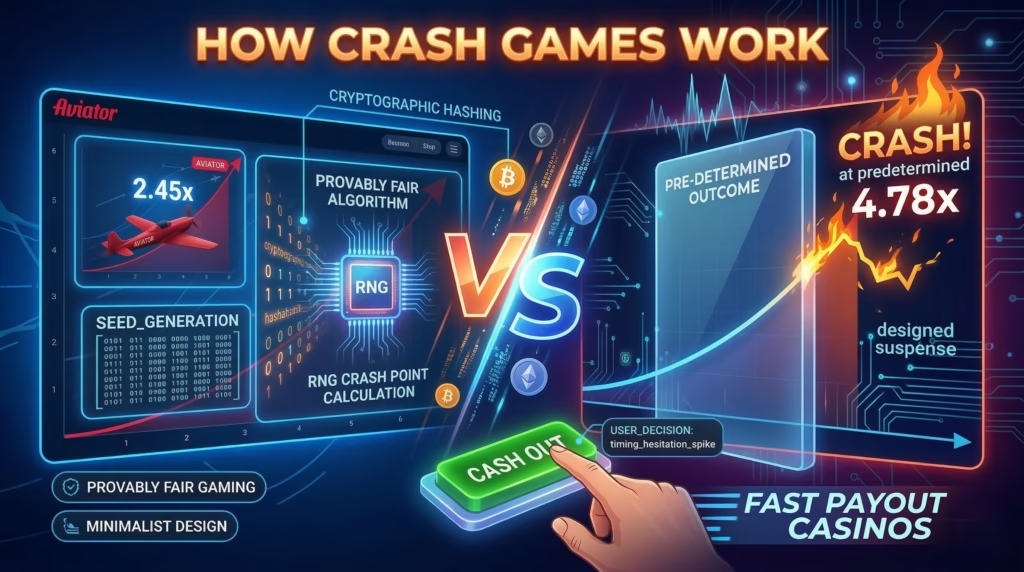
The multiplier isn’t climbing randomly in real time. The outcome of each round is usually determined before the round even starts.
I remember the first time I learned this. It felt counterintuitive. Watching the multiplier rise makes it seem like the game is calculating outcomes on the fly.
But that’s not what’s happening.
Instead, crash games typically use a random number generator (RNG) combined with cryptographic hashing. The system produces a value that determines the exact crash point for the round.
Once that value is generated, the result is locked in.
The game then reveals the multiplier gradually through animation until it reaches the predetermined crash point.
So the tension players feel while watching the multiplier rise? That’s essentially suspense created by presentation.
Actually, scratch that—it’s not just suspense. It’s carefully designed suspense.
Hot Take
In crash games, the drama you see on screen is mostly theater. The math already decided the ending.
The Role of Provably Fair Systems
Modern crash games often use a verification system known as provably fair technology.
The goal is transparency.
Before each round starts, the game generates a cryptographic hash tied to the upcoming result. After the round ends, players can verify that the multiplier was calculated from that hash.
This system helps support fair play gaming, which means the casino or game provider cannot secretly change outcomes once the round begins.
In theory, anyone can verify the result independently.
In practice, most players never bother checking.
I’ve noticed that players tend to trust the system more when verification exists—even if they never use it.
And honestly, that trust matters. Without it, crash games wouldn’t have grown nearly as fast as they have.
Pro-Tip
If you’re curious about how provably fair systems work, try checking the verification tool after a round. It’s one of the few ways players can confirm a game isn’t manipulating outcomes.
Why Multipliers Feel Random (Even When They’re Mathematical)
Here’s where things get interesting.
The multiplier distribution in crash games is designed to create a very specific pattern of outcomes.
Low multipliers happen frequently. High multipliers appear rarely.
This structure maintains the house edge while still creating occasional dramatic rounds where the multiplier climbs into double digits.
I’ve noticed that players often misinterpret these streaks.
A series of low multipliers appears and someone says, “A big one must be coming soon.”
But that’s not how probability works.
Each round is independent. The algorithm doesn’t remember previous results.
Even if the last five rounds crashed early, the next round still follows the same probability distribution.
The Vibe Check
Mood: Statistical reality versus player intuition.
Summary: Crash game multipliers look unpredictable because they’re designed to mimic chaotic patterns.
The Psychological Design of Crash Games
Here’s something many players overlook.
Crash games aren’t just mathematical systems. They’re psychological ones too.
The rising multiplier triggers anticipation. Every extra second feels like an opportunity.
I remember watching a friend play his first crash game. At 1.8x he said, “I’ll cash out at 2x.”
Then the multiplier hit 2x… and he hesitated.
Maybe 2.5x?
That hesitation cost him the entire bet when the round crashed at 2.3x.
The algorithm didn’t trick him.
But the design definitely encouraged him to wait just a little longer.
Developers know exactly how pacing, sound effects, and animation influence player behavior.
Hot Take
Crash games aren’t addictive because of the math. They’re addictive because of the timing.
How Crypto Payments Changed the Crash Game Ecosystem
Crash games didn’t rise in isolation. They appeared during a broader shift in online casino technology.
One big factor was the growth of crypto gambling trends.
Cryptocurrency payments allow faster deposits and withdrawals, which pairs perfectly with the quick pace of crash games.
Think about it.
A round might last ten seconds. Waiting three days for a withdrawal suddenly feels ridiculous.
That’s why players often look for platforms known for efficient payment processing. Discussions around fast payout casinos appear frequently in crash-game communities.
But it’s worth remembering something important.
Fast payments make the experience smoother—but they don’t change the math behind the multiplier.
The Vibe Check
Mood: Fast systems meeting fast gameplay.
Summary: Crash games and modern payment technology evolved side by side.
Is There Any Strategy Behind Crash Games?
This is the question that always shows up.
Players search for patterns. They test betting systems. Some even track multiplier histories hoping to predict the next round.
But crash games aren’t designed to be predictable.
The multiplier algorithm ensures each round is independent.
So there’s no guaranteed system that beats the game.
What players can control is risk management.
Some prefer early cash-outs around 1.5x. Others chase occasional large multipliers with tiny bets.
Neither approach eliminates the house edge, but it changes how volatile your session feels.
Interestingly, experienced players often approach crash games with the same mindset they bring to table games. Even discussions about disciplined live dealer strategy tend to focus on bankroll protection rather than trying to defeat probability.
Crash games compress that philosophy into a faster format.
Pro-Tip
If you want longer sessions, consider aiming for smaller multipliers rather than chasing huge ones. It won’t guarantee profit—but it may slow down the swings.
Responsible Play in High-Speed Games
Here’s something crash games don’t advertise loudly.
They’re incredibly fast.
A traditional blackjack session might involve a few dozen decisions per hour. Crash games can generate dozens of rounds in minutes.
I’ve seen players burn through a bankroll before they even realized how many rounds passed.
Setting limits helps.
Some players decide on a fixed number of rounds before starting. Others set a strict session budget.
It’s not glamorous advice, but it keeps the experience enjoyable instead of stressful.
The Vibe Check
Mood: Controlled discipline.
Summary: Fast games demand stronger self-control.
Final Thought: The Multiplier Is Only Half the Story
Crash games look simple on the surface.
A rising multiplier. A quick decision. A sudden crash.
But behind that simplicity sits a layered system of algorithms, probability, and psychological design.
The math decides the crash point.
The visuals create tension.
And the player decides when to jump.
I’ve noticed that people often obsess over the multiplier itself, trying to decode patterns or predict outcomes.
But the real lesson crash games teach is something simpler.
You’re not trying to control the algorithm.
You’re deciding how long you’re comfortable riding the climb.
And sometimes the smartest move isn’t waiting for the multiplier to reach the sky.
It’s knowing when you’ve already gone high enough.