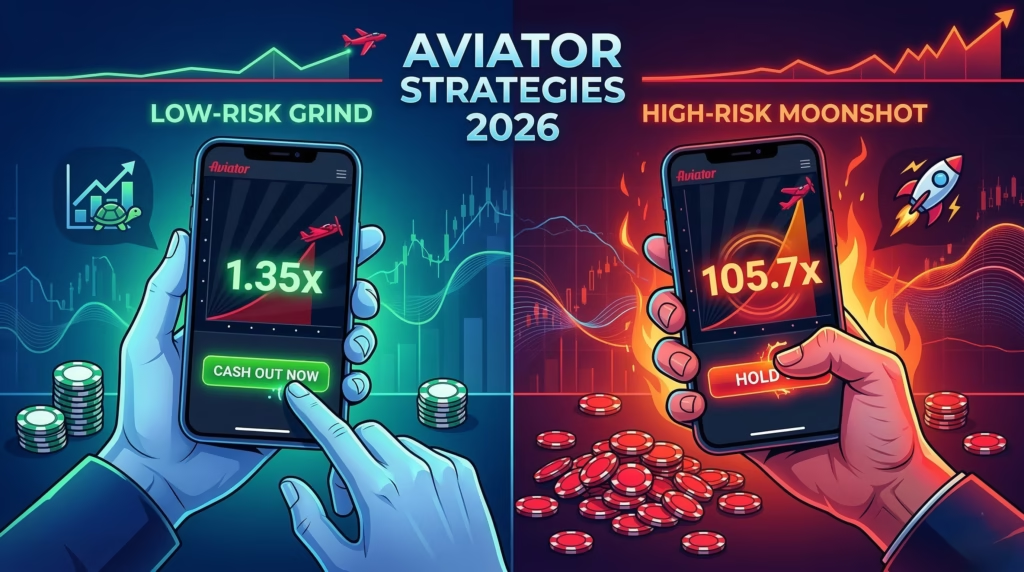
I remember when the first “crash” games started popping up in a few underground crypto corners. Back then, it felt like a weird experiment that wouldn’t last a week. Most people were too busy clicking “spin” on neon-soaked fruit machines to care about a tiny pixelated plane. But fast forward to 2026, and if you walk into any digital lobby, Aviator is the sun everything else revolves around. It’s the ultimate “vibe” game, but it’s also the ultimate trap for anyone who walks in without a plan.
I’ve noticed lately that the community is split into two very vocal camps. You’ve got the “Slow and Steady” crowd who treat it like a bank job, and the “Moonshot” crew who won’t touch the cash-out button until the multiplier looks like a phone number. There is no middle ground. You’re either a tortoise or a hare, and in this game, both can get cooked if they don’t know the math behind the curtain. Let’s break down the actual reality of these strategies without the marketing fluff.
1. The Low-Risk Grind: Playing for the Long Haul
The low-risk approach is basically the “Blue Chip” strategy of the crash world. The goal is simple: cash out early, cash out often. Most players in this camp are looking at multipliers between $1.10x$ and $1.35x$. It sounds boring, right? It is. But it’s also the only way to stay in the air for more than five minutes if your bankroll isn’t bottomless.
When you play this way, you’re betting that the plane won’t “instant-fly” at $1.00x$. It happens, and when it does, it hurts because you have to win ten times just to make back that one loss. However, the win rate here is technically higher. It’s about building a “cushion.” I’ve seen guys do this while watching a movie, just clicking the button like a reflex. It’s low-stress, but don’t confuse “low-risk” with “no-risk.” The house still has that tiny edge that eats you if you stay too long.
The Vibe Check: > Mood: Calm, methodical, and slightly repetitive. It feels like a desk job where you actually enjoy the coworkers (the live chat).
2. High-Risk: Chasing the Multiplier Dragons
Now, if the low-risk crowd is the accounting department, the high-risk players are the stunt pilots. This strategy involves waiting for the big ones—$10x$, $50x$, or even the legendary $100x$ plus. You’re going to lose. A lot. You might go twenty rounds without a single win.
The psychology here is different. You aren’t playing for the win; you’re playing for the hit. The danger is that high-risk play often leads to “chasing.” You see a $1.05x$ crash, then a $1.10x$ crash, and your brain tells you the big one is “due.” Actually, scratch that—the big one is never “due.” The RNG doesn’t care about your previous losses. But when it hits? That’s the “game-changer” that makes the front page of the live bet tracker.
Hot Take: > Most people who claim to have a “system” for hitting $100x$ multipliers are just lucky. There is no pattern in the flight logs. Stop looking for “signal” in the “noise.”
3. The “Double-Up” Hybrid (The Thinking Man’s Move)
If you can’t decide if you’re a tortoise or a hare, the dual-bet feature is your best friend. This is the closest thing to a live dealer strategy you’ll find in Aviator. You place two bets on the same round.
The first bet is your “Insurance.” You set it to auto-cash out at $1.50x$. If it hits, it covers the cost of both bets. The second bet is your “Moonshot.” You let that one ride into the sunset. If it flies away at $2.00x$, you’ve broken even. If it goes to $50x$, you’re the hero of the chat room. It’s a way to feel the thrill without the instant depression of a total loss.
Pro-Tip Box:
Set your “Insurance” bet to exactly double the amount of your “Moonshot” bet. If you cash the insurance at $1.50x$, you’ve paid for the entire round and can watch the second plane with zero stress.
4. Why Tech Matters in 2026: The Speed Factor
We can’t talk strategy without talking about the “pipes” the game runs on. In 2026, the biggest enemy of any Aviator player isn’t the multiplier—it’s lag. If you’re trying to hit a $1.20x$ cash out on a jittery connection, you’re going to have a bad time.
This is why we’ve seen such a massive surge in crypto gambling trends. Blockchain-based platforms handle the “instant” nature of these games way better than old-school bank rails. When you click “Cash Out,” you need that command to hit the server in milliseconds. Plus, knowing that the game is built on fair play gaming tech means you aren’t guessing if the server “cheated” you out of a win. You can actually verify the seed of the flight. If the plane flew away, it’s because the math said so, not because the site felt like keeping your tenner.
5. Managing the “Crash” (Personal Bankroll)
I remember when I first started playing, I’d get a few good wins and suddenly I thought I was invincible. I’d double my bet size, then triple it. That’s how you go from “pilot” to “passenger” real quick.
The real “secret” strategy? Only bet what you’re willing to set on fire. Seriously. Treat your Aviator balance like a movie ticket. You’re paying for the entertainment of the flight. If you walk away with more than you started, you got a free show. If you lose it, the show’s over. I’ve noticed lately that the most successful players (the ones who are still playing a year later) are the ones who never change their base bet, regardless of whether they just won or lost.
6. The 2026 Mobile Experience
Let’s be honest, most of us are playing this while waiting for a bus or during a boring meeting. The shift toward mobile slots 2026 aesthetics has influenced Aviator too. The interface is cleaner, the buttons are bigger, and the “Auto-Play” features are more robust.
But playing on mobile adds another layer of risk: distractions. A stray notification or a phone call at $5.00x$ can be the difference between a win and a wipeout. If you’re going for a high-risk strategy, find a quiet corner. If you’re just grinding low-risk, the mobile “snackable” experience is fine. Just don’t blame the game if your mom calls right when the plane hits its peak.
The Vibe Check: > Mood: Distracted but hopeful. Mobile play is for the “in-between” moments, but don’t let the convenience make you reckless.
7. The Final Reality Check: House Edge vs. Ego
At the end of the day, Aviator is a game of chicken where the other guy (the casino) has infinite patience and a bigger gas tank. Whether you use a low-risk “martingale” style or a high-risk “all-or-nothing” approach, the math eventually catches up.
The game is popular because it gives us the illusion of control. And that’s fine! That’s why we play games. But don’t let your ego tell you that you’ve “solved” the plane. You haven’t. You’re just a passenger on a very fast, very random flight. Enjoy the view, talk some trash in the chat, and know when to unbuckle your seatbelt and walk away.
The Final Thought
So, which one is better? Low-risk is for the grinders who want to play for three hours on fifty bucks. High-risk is for the adrenaline junkies who want a story to tell. There is no “correct” way to play, only the way that fits your personality and your budget.
In the 2026 landscape, with fast payout casinos making the wins (when they happen) hit your wallet instantly, the temptation to jump back in is stronger than ever. My advice? Pick a strategy before you open the app. If you decide to be a low-risk player today, don’t let a “Hot Streak” in the chat lure you into a $50.00x$ chase. Stick to your flight plan, and you might actually enjoy the landing.
FAQ: Your Burning Aviator Questions
No. Every round is generated by a random seed that combines server data with player data. It’s mathematically impossible to predict the next crash based on the last one.
That’s the "house edge" in action. It’s the casino’s way of ensuring that even the "auto-cash out at 1.01x" players eventually lose. It’s rare, but it’s part of the math.
For low-risk strategies, Auto-Cash Out is a fast payout casinos staple because it removes human hesitation. For high-risk, manual play is better because you might want to "feel" the momentum of a big run.
Absolutely not. Whether you bet $0.10 or $100, the plane is going to fly away at the same time for everyone in that round.
It’s a system where the game’s outcome is encrypted before the round starts. After the round, you can use a key to verify that the result wasn't changed based on how much people bet. It’s the gold standard of trust in 2026.