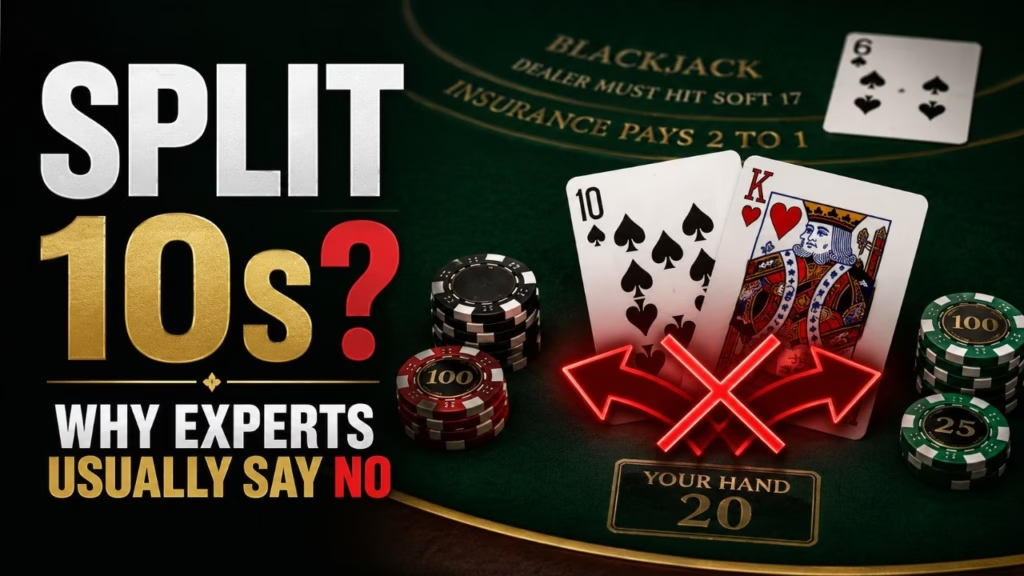
If you are holding two 10s in blackjack, it can feel tempting to split them when the dealer shows a weak card. After all, two hands might seem like a chance to win twice as much. But when players ask should you split 10s in blackjack, the answer from basic strategy is usually no. Mathematical models have shown that splitting a made 20 is one of the most common and costly mistakes a player can make.
The reason is simple: a total of 20 is already an excellent hand. You are not fixing a weak position; you are breaking up a very strong one. Instead of keeping a hand that is likely to win or at worst push, you turn it into two new hands that often start with less value and more uncertainty.
Why Splitting 10s Is a Statistical Mistake
 In blackjack, a hard 20 is the second-strongest total you can hold, behind only a natural blackjack. That means you are already in a powerful position before the dealer even acts. Standing on 20 protects that strength.
When you split 10s, you take a near-lock situation and turn it into two separate hands that have to be built from scratch. Each hand starts with only 10, which is a far more fragile total. You now need to draw well twice, while the dealer still follows the same rules.
Basic Strategy exists because researchers studied millions of blackjack outcomes and used mathematical methods and simulations to find the move with the best long-term result in each situation. The strategy was developed from the work of early blackjack researchers such as Baldwin and later refined through computer analysis. Those studies consistently show that keeping 20 intact is usually better than splitting it.
For beginners, the key idea is this: blackjack is not about making the most exciting move. It is about making the move that gives you the best expected value, or EV. EV is a simple way to describe how much you can expect a decision to return over the long run. Standing on 20 has a much stronger EV than splitting 10s in standard game conditions.
The Math: Standing on 20 vs. Splitting 10s
Standing on 20 means you are letting a very strong hand do its job. The dealer has to beat 20 without busting, which is difficult. In many rounds, the dealer will end up with 17 through 19, bust, or push with 20. That is why a 20 is such a valuable hand.
Splitting 10s changes the math in a way that usually hurts the player. You are no longer betting on one powerful hand. You are betting on two uncertain starts, and both of them can end up as 12, 16, or some other weak total. Even if one of the split hands improves, the other hand can still lose value quickly.
Here is the simplest way to think about it: a strong hand that is already near the top of the range is worth more than two weaker hands with higher variance. The possible upside of “winning twice” sounds appealing, but the downside is that you are giving away a hand that already has excellent winning power.
Breaking Up a Guaranteed Strength
Nothing in blackjack is guaranteed, but 20 is as close as you get to a near-guaranteed strong position. It wins against most dealer finishing totals and often forces a push when the dealer also reaches 20. Because of that, standing on 20 is a disciplined decision rather than a passive one.
When players split 10s, they often focus on the possibility of turning one big win into two medium wins. The problem is that the hand you are breaking apart is already better than most of the hands you could create from it. In practical terms, you are trading certainty for hope.
That trade is usually negative for the player. Basic Strategy does not care what feels exciting. It cares about the move that loses the least, or wins the most, over time.
The Dealer’s Perspective
It helps to look at the hand from the dealer’s side. The dealer does not make creative choices. They follow fixed rules, usually hitting until 17 and standing on 17 or higher. That means the dealer’s result is partly predictable.
When you already have 20, the dealer has a difficult job. They need to beat you without busting. When you split 10s, you give the dealer a better chance to do exactly what the rules allow: survive long enough to beat your weaker follow-up hands. In other words, splitting often helps the dealer more than the player.
This is why seasoned table players rarely support splitting 10s. It is not just because it looks risky. It is because the hand you are destroying was already doing the hard work for you.
Why Beginners Get Tempted to Split
The temptation usually comes from seeing a dealer upcard like a 5 or 6. That looks like a weak dealer hand, so a new player thinks, “This is my chance to press the advantage.” The thought is understandable, but it often comes from emotion rather than math.
Another reason is the feeling of “doubling your money.” If you split 10s and win both hands, it can look like a smart aggressive play. But good strategy is not judged by the best possible outcome in one hand. It is judged by the average outcome over many hands.
This is a classic case of outcome bias. Outcome bias happens when a decision feels right because the result turned out well, even if the decision was poor. If someone splits 10s and somehow wins both hands, that does not make the move correct. It only means the cards were kind that time.
Beginners also often underestimate how valuable a standing 20 is. They see only the chance to “make more,” not the risk of breaking a winning hand. Experienced players know that blackjack rewards patience. Sometimes the smartest move is to leave a strong hand alone.
Helpful Interactive Tool or Visual to Add
The 20 vs. Split 10s
This quick comparison shows why standing on 20 is usually stronger than splitting 10s. It is a simple at-a-glance reminder that the hand you already have is one of the best possible totals.
| Holding 20 | Splitting 10s |
|---|---|
| Strong total that often wins or pushes | Two new hands that must improve from scratch |
| High expected value in standard rules | Lower expected value and more variance |
| Forces the dealer to beat a very hard hand | Gives up a near-winning position |
| Usually the correct Basic Strategy play | Usually a mistake for recreational players |
Why this is a bad idea: You are replacing a strong made hand with two weaker hands. That increase in risk rarely pays off under standard blackjack rules.
Note: These statistics are based on standard 6-deck casino blackjack rules. Variations in house rules change these probabilities.
Are There Any Exceptions?
There is one advanced exception: some highly skilled card counters may sometimes split 10s when the remaining deck is unusually rich in 10-value cards and aces. In that very specific situation, the math can shift enough to make the split more attractive.
That is not normal play for the average casino visitor. It requires precise deck tracking, discipline, and a full understanding of advanced advantage play. For most players, the best advice stays the same: do not split 10s.
Also, table etiquette matters. Seasoned players often react immediately when someone splits 10s because they know how rarely it is the right move. While etiquette should never matter more than strategy, the social pressure at a table is another reason this decision gets noticed.
Responsible Play and Basic Strategy
 Basic Strategy is the mathematical foundation of solid blackjack play. It was built from research and simulations, not gut feeling. Its purpose is to reduce the house edge as much as possible under normal rules.
That said, no strategy removes the house edge completely. Even perfect Basic Strategy still leaves the casino with an advantage over the long run. Blackjack is a game of chance, and short-term results can swing wildly. A player can make the right decision and still lose the hand.
That is why responsible play matters. Set a budget before you sit down, treat losses as the cost of entertainment, and avoid chasing them. If you play at a casino, also check the local laws, age rules, table rules, and the specific game rules before you bet. Small rule changes can affect the value of each decision.
For most players, the smartest mindset is not “How do I force a win?” but “How do I avoid common mistakes?” Splitting 10s belongs on the mistake list. Standing on 20 is the disciplined choice.
FAQ
Is it ever okay to split 10s?
For most players, no. The only common exception is advanced card counting situations where the deck composition makes the split mathematically favorable.
Does the dealer’s upcard matter when I have 10s?
In standard basic strategy, not enough to justify splitting. A hard 20 is strong against any dealer upcard, so standing is usually correct.
What is the biggest mistake new players make in blackjack?
Two of the biggest mistakes are splitting 10s and failing to double down correctly when the math supports it.
Does Basic Strategy guarantee I will win money?
No. Basic Strategy only reduces the house edge. It improves your odds over time, but it does not guarantee profit.
What should I do if I accidentally split 10s?
Do not try to “fix” it by chasing losses. Accept the result, learn from the mistake, and follow the strategy chart on your next hand.