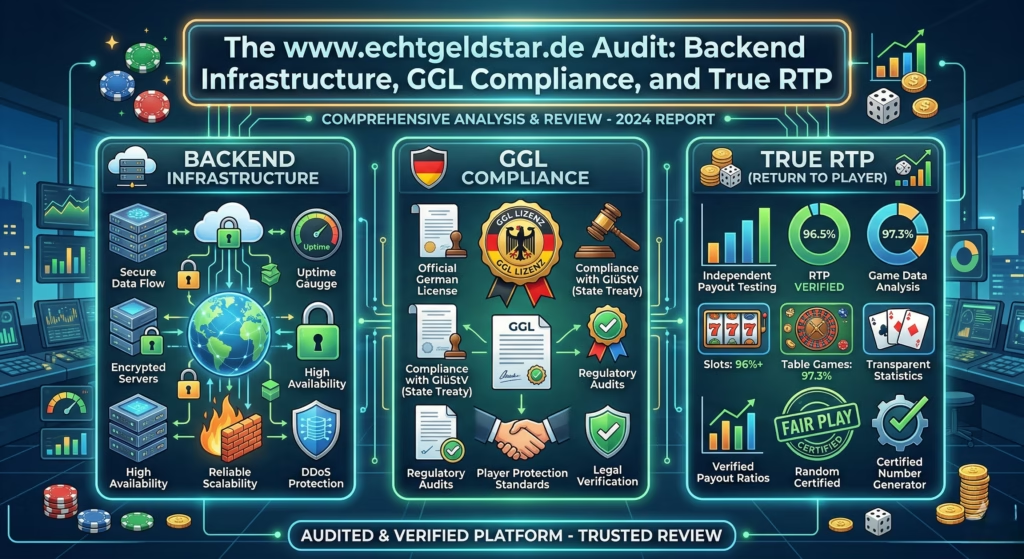
The landscape of Echtgeld Casinos Deutschland has fundamentally changed. We are no longer operating in the gray-market era of offshore licenses and arbitrary terms and conditions. Today, assessing a platform like www.echtgeldstar.de requires looking past the frontend marketing and dissecting the backend regulatory infrastructure. As analysts, we evaluate the mathematical realities of the games, the friction within the payment pipelines, and the strict adherence to the State Treaty on Gambling (GlüStV).
When you sit down to evaluate a platform in this jurisdiction, the welcome offer is irrelevant. The true test lies in how the operator handles cryptographic game verification, mandatory deposit routing, and Anti-Money Laundering (AML) protocols. This audit breaks down the structural realities of www.echtgeldstar.de for the informed player who understands that the house always has an edge, but demands absolute transparency in how that edge is applied.
Regulatory Architecture: Surviving the GGL Framework
The primary metric of trust in the current market is the GGL Lizenzprüfung. A platform operating legally in Germany cannot exist as an isolated island; it must act as a node connected to federal oversight databases.
Our methodology: We evaluate platforms strictly on integration efficiency with state databases, RTP transparency, KYC latency, and the functional deployment of responsible gambling tools.
When you register at www.echtgeldstar.de, your data isn’t just sitting on their private servers. The platform is legally required to ping the OASIS database (the national player barring system) simultaneously. If you are flagged in OASIS, the operator’s backend must instantly reject the account creation or login attempt. There is no manual override.
OASIS and LUGAS Integration Realities
The second layer of this regulatory architecture is LUGAS, the central IT system for deposit limits. The GlüStV mandates a cross-platform deposit limit of €1,000 per month.
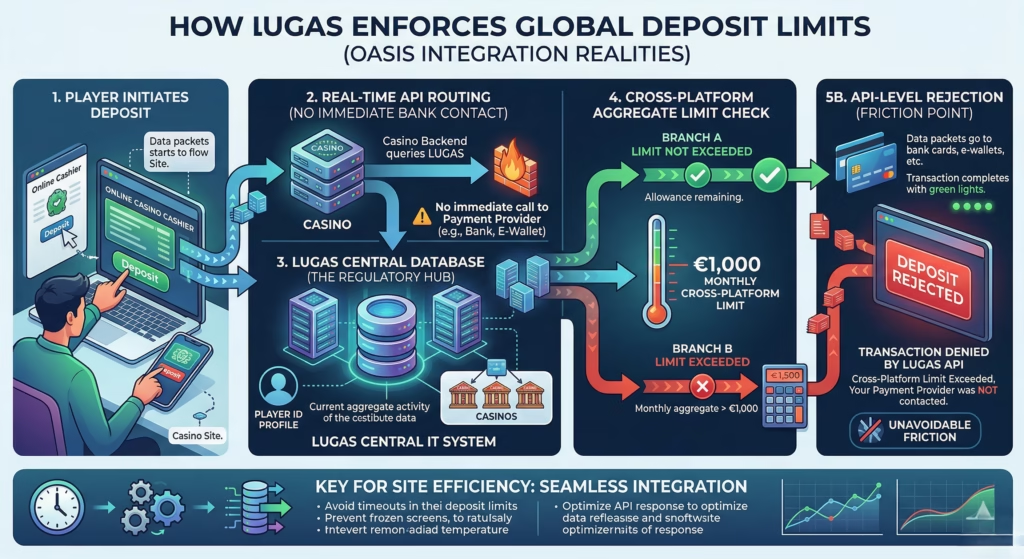
When you initiate a deposit on this platform, the cashier system does not simply communicate with your bank or e-wallet. It must first query the LUGAS server to verify how much of your €1,000 monthly allowance remains across all legal operators. If your attempted deposit exceeds this aggregated limit, the transaction is rejected at the API level before your payment provider even sees it. This causes unavoidable friction, but understanding this routing is essential. The efficiency of a site relies entirely on how seamlessly their API handles these LUGAS requests without causing false timeouts or frozen cashier screens.
Game Mathematics: Analyzing the House Edge
The second pillar of our analysis moves away from the legal framework and into the actual math. The days of assuming a slot machine runs at a static 96% Return to Player (RTP) are over. Software providers now offer operators configurable RTP brackets.
To conduct a proper evaluation, you must learn to navigate the game’s help files to RTP Werte vergleichen. It is entirely possible to play the exact same Book of Ra or Reactoonz variant on two different licensed sites and face two different mathematical disadvantages.
The Impact of the German Tax Law on Payout Percentages
When analyzing the RTP on any legal German platform, you have to account for the 5.3% tax levied on stakes (turnover), not gross gaming revenue. This legislative decision fundamentally alters the math model of every game.
Because the operator must pay 5.3 cents on every €1 wagered, regardless of whether that spin wins or loses, they cannot mathematically sustain a 96% RTP game. Consequently, you will notice that the RTP on legal platforms is structurally capped closer to 88% to 90%. This is not a hidden scam by the operator; it is a forced mathematical adjustment to remain solvent under the current tax code. You are trading a higher house edge for the legal protection of the GGL.
The Withdrawal Pipeline: KYC Friction and Clearing Times
The most critical stress test for any operator is the withdrawal pipeline. Marketing departments love to promise instant payouts, but the reality of modern iGaming is governed by strict AML directives. Real Auszahlungsdauer Erfahrungen are dictated not by the casino’s generosity, but by their compliance department’s efficiency.
Before a single euro leaves the platform, a withdrawal request triggers a chain of verification checks. Have the deposited funds been wagered at least once (the standard AML rule)? Does the destination account exactly match the verified identity on the casino profile?
The table below illustrates the structural latency inherent in different payment gateways once the compliance team has cleared the transaction.
This table outlines the realistic technical settlement times after internal KYC clearance is granted, ignoring marketing claims.
| Payment Protocol | Infrastructure Type | AML Clearing Latency | Technical Settlement Time |
|---|---|---|---|
| SEPA Bank Transfer | Legacy Banking | High (Manual review common) | 24 – 72 Business Hours |
| PayPal | E-Wallet Integration | Medium (Pre-verified by PayPal) | Instant to 4 Hours |
| Trustly / Sofort | Open Banking API | Low (Bank-level API handshake) | Instant to 12 Hours |
| Visa / Mastercard | Card Network | High (Chargeback risk assessment) | 48 – 96 Business Hours |
Structural Limits and Player Agency
Operating a platform in the modern era requires a robust, proactive approach to player safety. We do not look for vague links to help organizations hidden in the footer; we look for hardcoded structural limits within the user interface.
Legal platforms are required to enforce strict Spielerschutz Limits. Beyond the federal LUGAS deposit cap, the platform’s internal architecture must allow players to establish loss limits, session time limits, and wager limits that take effect immediately upon activation.
More importantly, the GlüStV enforces a mandatory €1 maximum bet per spin on virtual slot machines, and a minimum spin duration of 5 seconds. This is designed to reduce the velocity of play and disrupt the trance-like state often associated with rapid-fire variance.
If you find yourself chasing losses or attempting to circumvent these built-in delays, the infrastructure is designed to halt you. The presence of a prominent “Panic Button” (Panik-Button), which instantly enforces a 24-hour self-exclusion, is a mandatory UI requirement. Accessing these [Internal Link Placeholder: Responsible Gambling Tools Overview | anchor: “responsible gambling tools”] is not an admission of defeat; it is a tactical management of your bankroll and exposure to variance.
Final System Audit
Evaluating www.echtgeldstar.de requires abandoning the mindset of a casual player and adopting the lens of an auditor. The platform is bound by the strictest regulatory framework in Europe.
You must assume that the house edge is elevated due to the turnover tax, and that your session velocity will be throttled by the 5-second rule. Your deposits are permanently tethered to the LUGAS database, and your withdrawals will be subjected to uncompromising AML scrutiny.
If you choose to engage with Echtgeld Casinos Deutschland, you must do so with a clear understanding of these mechanics. Run your own GGL Lizenzprüfung by checking the official whitelist before depositing. Take the time to RTP Werte vergleichen by opening the game rules before spinning. Accept that Spielerschutz Limits are hardcoded into the experience, and factor the unavoidable KYC delays into your personal expectations regarding withdrawals. This is the reality of regulated, analytical play in 2026.