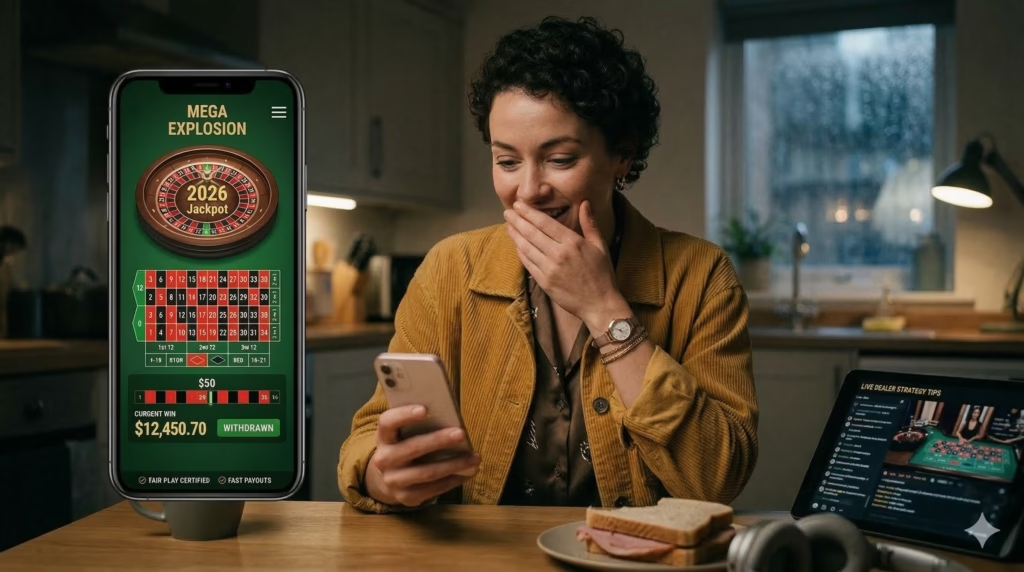
I remember when I first sat down at a digital roulette table. I thought I had it all figured out. I’d watched a few movies, seen the glamorous shots of Monte Carlo, and figured that as long as I stuck to the “even money” bets, I couldn’t really lose my shirt. Fast forward to 2026, and while the interface is a lot slicker—think 4K streams and haptic feedback—the math hasn’t changed a bit.
Lately, I’ve noticed that even with all the tech at our fingertips, people still get tripped up by the basics. They see a wheel spinning and think “it’s due for a red.” Actually, scratch that—the wheel doesn’t have a memory. It’s just physics and probability wrapped in a fancy digital skin. If you’re going to spend your time at the table, you might as well understand the engine under the hood.
1. The Zero Problem: European vs. American Wheels
The first thing you’ve got to realize is that not all wheels are created equal. If you’re playing on a wheel with a double zero (00), you’re basically giving the casino a head start. In the US version, that extra pocket jumps the house edge up to about 5.26%. Contrast that with the European wheel, which has a single zero and a much more palatable 2.7% edge.Choosing the right wheel is a total no-brainer. Why would you play a game where the house has twice the advantage? I’ve seen players in high-stakes lobbies ignore this all the time because they like the “aesthetic” of the American table. Don’t be that person. In the world of fair play gaming, transparency is key, and the math is right there in the open.
The Vibe Check: > Mood: Methodical. Before you place a single chip, check the wheel. If there’s a ’00’, walk away.
2. The Math of Inside vs. Outside Bets
Roulette is divided into two worlds: the high-risk “Inside” and the steady “Outside.” Inside bets are the ones where you pick specific numbers or small groups of them. A “Straight Up” bet pays 35:1. It feels great when it hits, but the probability of that happening is roughly 2.7% (on a single-zero wheel).
Outside bets are your reds, blacks, evens, and odds. They pay 1:1. It’s not flashy, but your odds of winning are nearly 48.6%. It’s the closest thing to a coin flip you’ll find in a casino, though the zero ensures it’s never quite 50/50.
I’ve noticed lately that the “savvy” crowd tends to lean toward the outside. It’s a slow-burn strategy that keeps you in the game longer. If you’re looking for a quick thrill, go inside, but don’t be surprised when the bankroll vanishes in three spins.
3. The Myth of the “Hot” and “Cold” Numbers
In 2026, every digital table comes with a “statistics” board showing you the last 20 winning numbers. It’s tempting to look at a string of five blacks and think, “Red has to be next.” This is the classic Gambler’s Fallacy.
Each spin is an independent event. The ball doesn’t know where it landed thirty seconds ago. It doesn’t care. I remember watching a guy dump his entire balance on ’17’ because it hadn’t come up in two hours. It still didn’t come up. Understanding roulette odds means accepting that the board is there for entertainment, not for prediction.
Hot Take: > Statistics boards are the biggest trap in the industry. They’re designed to make you feel like you’ve spotted a pattern in pure chaos. Treat them like a weather report from three weeks ago—interesting, but useless for today.
4. Advanced Play: Racetracks and Call Bets
If you’ve spent any time at the higher-limit tables, you’ve probably seen the “Racetrack.” This allows for more complex bets like Voisins du Zéro (Neighbors of Zero) or Tiers du Cylindre. These aren’t just for show; they allow you to cover large sections of the wheel with fewer clicks.
This is where a solid live dealer strategy comes into play. By covering specific physical sections of the wheel rather than just numerical patterns on the felt, you’re hedging against “sector” landings. It doesn’t change the house edge, but it does change the “feel” of the game. It makes it feel more like a strategic battle than a blind guess.
Pro-Tip Box: If the dealer has a very consistent “release” (the physical way they drop the ball), sector betting on the racetrack can feel more rewarding. Just remember that modern casinos calibrate their wheels to avoid any predictable “bias.”
5. Managing the Bankroll: The Real “Win”
You can know the odds of every single bet on the table, but if you don’t manage your chips, you’re done for. Roulette is a high-variance game. You can go on a heater where every red hits, followed by a cold streak that feels like an ice age.
In the world of crypto gambling trends, where everything moves at lightning speed, it’s even easier to lose track. I’ve noticed that the players who stay at the table the longest are the ones who use a “unit” system. If your bankroll is $100, your unit might be $2. You never bet more than five units on a single spin. It sounds boring, but it prevents the “tilt” that happens after a bad loss.
6. The Digital Edge: Payouts and Fair Play
Actually, scratch that—the math is only half the battle. The platform you choose is the other half. In 2026, we have the luxury of fair play gaming certifications. You can check the RNG (Random Number Generator) or the cryptographic seed of the game to ensure the ball isn’t being “helped” into a pocket.
Furthermore, with the rise of fast payout casinos, the sting of a losing session is at least mitigated by the knowledge that your winnings (when you have them) are actually yours. There’s nothing worse than hitting a lucky ‘Straight Up’ bet only to have the site tell you it takes 48 hours to process the withdrawal. Speed and transparency are the new gold standard.
The Vibe Check: > Mood: Sharp. Use the tech to your advantage. Verify the seeds, use the auto-limit tools, and only play where the payouts are instant.
7. Responsible Play: The Only Way to Stay Grounded
Look, let’s be real. Roulette is a game where the house always wins in the long run. That’s how they pay for the 4K cameras and the professional dealers. You are paying for the adrenaline and the experience.
The moment you start trying to “make back” what you lost, you’ve already lost the mental game. I’ve found that setting a “loss limit” is much more important than a “win goal.” If you hit your limit, close the app. Go for a walk. The wheel will still be spinning tomorrow.
Integrating your play into your life rather than letting it take over is the mark of a savvy player. We’re here for the “vibe,” the community, and the occasional rush of a winning number. If it stops being fun, it’s not a game anymore—it’s a chore.
The Final Thought
Understanding roulette odds isn’t about finding a “secret” to winning. It’s about stripping away the mystery so you can enjoy the game for what it is. It’s a beautifully simple game of chance that has survived for centuries because the tension of that spinning ball is universal.
Whether you’re playing on the latest mobile slots 2026 apps that feature hybrid roulette mechanics or sitting at a high-stakes live table, the numbers don’t lie. Stick to the European wheel, manage your units, and don’t let the statistics board get in your head.
Play smart, stay cold, and remember: the ball has no master.
FAQ: The Short and Sweet Versione
Outside bets like Red/Black or Even/Odd have the best probability of winning (roughly 48.6% on a European wheel)
In theory, yes. In reality, no. Table limits and bankroll exhaustion usually stop you before you can recover your losses. It's a high-risk gamble that often ends in a wipeout.
It’s a specific rule found on some European tables where if you place an even-money bet and the ball lands on zero, your bet is "imprisoned" for the next spin rather than lost. It lowers the house edge even further.
If you’re playing at a licensed and regulated site that uses fair play gaming tech, then no. The outcomes are determined by a verified RNG or a physical wheel in a controlled studio.
The extra "00" pocket increases the house edge from 2.7% to 5.26%, making it significantly harder to stay in the green over time.