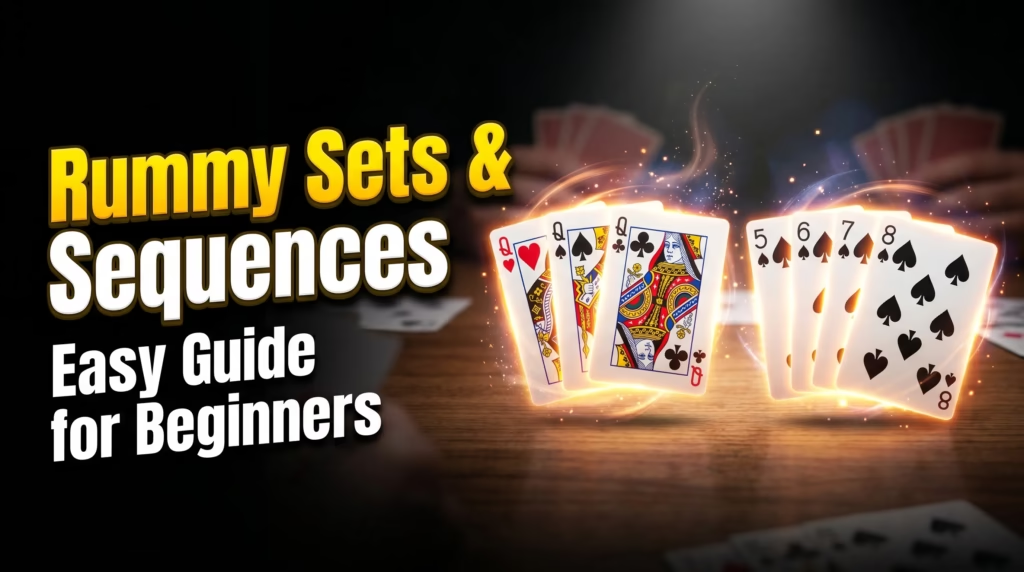
Have you ever found yourself confused playing rummy upon hearing concepts like “pure sequence” or “valid set”? You aren’t the only one, as most beginners lose because of their unawareness about rummy sets and sequences rather than due to ill luck. Rummy sets and sequences are essential to the game and their accurate construction is what differentiates playing by luck from playing by control.
We will explore here: What are sets and sequences, their significance, and how to construct them, in addition to the tactics by which professionals master it.
What Are Rummy Sets and Sequences in Simple Terms?
The basic objective in Rummy is to arrange your 13 cards into valid sets and sequences much before the rest, so that you can make a declaration.
Set: A group of 3–4 cards of the same rank but different suits (e.g., 7♥, 7♦, 7♠). Think of these like strong players on a team!
Sequence (Run): Consecutive cards of the same suit (e.g., 4♣, 5♣, 6♣). It can be a pure sequence (without a Joker) or an impure sequence (with a Joker).
In any valid hand, there must be at least 2 sequences (one should be pure), other combinations should be in sets. Otherwise good cards will be of no use! Master this with practice.
Why Are Sets and Sequences Important in Rummy?
In Rummy, whether you are playing at a online casino, it is not sufficient to just get the cards in groups; you need to do so validly according to the Rummy rules.
- At least 2 sequences are required (one pure sequence is mandatory, without a Joker).
- The remaining cards can be completed using sets.
These rules exist to prevent random grouping and to encourage planning, observation, and pattern recognition. If you declare without following these rules, your hand will be considered invalid—even if it looks complete.
Practical use: Focus your strategy on building sequences first (especially the pure sequence), then form sets. This makes declaration faster.

What Is a Sequence in Rummy?
A sequence consists of 3 or more consecutive cards of the same suit. Sequence plays a crucial part of Rummy. Having sequences are very essential to make a valid hand and win the game.
Types of Sequences in Rummy:
What is a Pure Sequence?
The pure sequence is the most essential combination in Rummy; in a pure sequence no joker is used. It means, a sequence formed by natural and consecutive cards of the same suit, correctly organized and without using a replacement.
Example:
5♠, 6♠, 7♠
In each Rummy game as it is commonly played, it is obligatory to lay down at least one pure sequence. If you do not have a pure sequence among your hand of cards, your declaration is not valid, even though all the other cards in your hand are well-placed.
The purpose of this rule is simple: it ensures that players focus on genuine skill and planning, rather than relying on jokers to make easy combinations.

What is an Impure Sequence?
An impure sequence is a sequence in which a joker is used to replace a missing card.
Example:
8♦, Joker, 10♦
In this example, the joker represents 9♦.
Impure sequences are more flexible and relatively easier to complete. They help you recover from a weak starting hand and allow you to progress faster in the game.

What Is a Set in Rummy?
In Rummy, a set is a group of 3 or 4 cards of the same rank but from different suits.
Example:
Q♣, Q♦, Q♥ (or Q♠)
Sets are easier to form compared to sequences because the order of cards does not matter. However, sets are not mandatory for a valid declaration, though they help in reducing your score.
Types of Rummy Sets:
- Natural Set: 3–4 cards of the same rank from different suits, without using any Joker.
- Joker Set (Impure Set): A set formed using a Joker.
Pro Tip: Jokers help complete sets quickly, but if you rely solely on them and ignore sequences (especially the pure sequence), your overall strategy can become weak.
Key Rules for Valid Sets and Sequences
Understanding the rules is essential to avoid costly mistakes. A valid hand must follow these principles:
- Sequence: Must have at least 3 consecutive cards of the same suit.
- Set: Cards must be of the same rank, but suits should be different (duplicate suits are not allowed).
- Pure Sequence: At least one sequence must be “pure” (mandatory)—no jokers can be used in it.
- Joker Limit: Jokers can be used in sets, but they cannot be used in sequences.
These rules are not just technical; they define every move you make and shape your long-term strategy.
Common Mistakes Beginners Make
Beginners often fall into these mistakes that can ruin their game:
- Ignoring the pure sequence: The biggest mistake—at least one pure sequence (without a Joker) is mandatory for a valid declaration. Declaring without it will make you lose.
- Over-reliance on jokers: Trying to form sets only using jokers. Jokers cannot be used to make a pure sequence—this weakens your overall strategy.
- Adding duplicate cards of the same suit in a set: A set must have cards of the same rank but from different suits. Making an invalid set like 7♥, 7♥, 7♦ will result in penalty points.
- Focusing on small sequences: Instead of forming 3-card sequences, wait to form 4–5 card sequences—longer sequences reduce deadwood points.
- Declaring too early: Declaring just because the hand looks almost complete without checking for a pure sequence. This is the most costly mistake.
- Picking risky cards from the discard pile: Gives opponents a hint about what you are trying to form.
Quick Fix: Form the pure sequence first, then sets. Check your hand before every turn—this small habit can change the game.
Conclusion: Master Rummy with Sets & Sequences
Rummy is all about sets and sequences and your ability to identify and create these is essential if you want to play and win consistently. This article has covered the basics as well as pitfalls to avoid. You have learned all you need to know; practice: ensure you form your pure sequence and sets and review your hand prior to playing each card.
The more you play these things become second nature and you will consistently keep you ahead of the others playing at the table. Start playing today and make your first valid declaration!
Rummy Sets and Sequences FAQs: Common Questions Answered