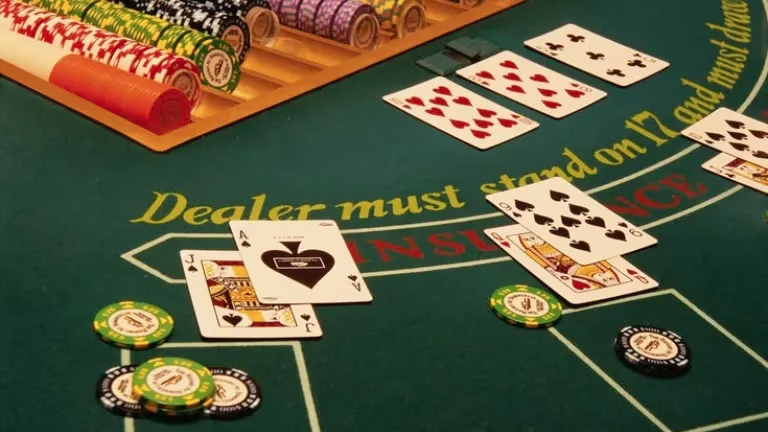
Yes — when you split in blackjack, you usually must place an additional bet equal to your original wager. That is because a split turns one hand into two separate hands, and each hand needs its own stake. So if you bet $10 and split a pair, you normally put up another $10 and play two hands for a total of $20 at risk.
This is one of the most common points of confusion for new players. The rule feels like a “double,” but it is not the same thing as the blackjack move called doubling down. A split means you are separating a pair and continuing with two independent hands, each with matching bet requirements.
The Short Answer: Why You Must Double Your Bet
 The short answer is yes: to split in blackjack, you generally must match the original wager. Casinos require that because you are no longer playing one hand. You are creating two hands, and each one carries its own financial stake.
Think of it this way: when the dealer deals you a pair, you have one hand with one bet attached to it. If you decide to split, the casino gives you a second hand and expects a second bet of the same size. That second wager is not a bonus charge or a fee. It is the stake for the new hand.
Standard blackjack terminology matters here. “Matching the original wager” is the clearest way to describe it. If your first bet was $25, your split usually requires another $25. If your first bet was $100, you need another $100.
There are slight table-rule variations in some casinos, but the basic idea is the same at most blackjack tables. Splitting is treated as two hands because each hand can win, lose, or push on its own.
How a Blackjack Split Works in Practice
Here is a simple step-by-step example of how the process works at the table.
- The deal: You place a $10 bet and receive two 8s.
- The choice: Because you have a pair, the rules allow you to split.
- The stake: You place another $10 next to your original wager to create a second hand.
- The result: You now play out two separate hands against the dealer.
After the split, the dealer usually gives one new card to each 8. Your first hand might end up strong, while your second hand might be weak. That is normal. The key point is that each hand is resolved separately.
For example, one split hand could win, while the other loses. You could also win both, lose both, or have one hand push. That is why splitting changes your bankroll exposure. You are putting more money on the table, but you are also giving yourself two chances to improve a favorable pair.
The important detail is that the extra bet is not optional if you want to split. If you do not want to commit the additional money, you simply keep the original hand as it is.
Helpful Interactive Tool or Visual to Add
Here is a simple way to picture the split:
| Before the Split | After the Split |
|---|---|
| Initial Bet: $10 | Hand A: $10 |
| One pair in one hand | Hand B: $10 |
Split Bet Visualization Box: one hand becomes two hands, and each hand carries a matching wager.
That is why the total amount at risk increases immediately after the split. Your stake on the table moves from $10 to $20 in this example.
Safety note: Splitting is a strategic move, not a guaranteed way to win. Always manage your bankroll, and never treat a split as a sure profit opportunity.
Is It Always Smart to Split?
The mechanics of splitting are fixed, but the decision to split is not always the best one. Whether a split is smart depends on the cards, the dealer’s upcard, and the table rules.
Basic strategy, which is the mathematically informed approach most experienced players follow, recommends splitting some pairs because they have better long-term value as two hands than as one. A common example is splitting Aces. Another frequent example is splitting 8s, because two 8s make a weak total of 16, while two separate hands give you more flexibility.
On the other hand, some pairs are usually poor candidates for splitting. Many players avoid splitting 10s because a total of 20 is already very strong. Likewise, 5s are often better played as a 10, which gives you more useful options than turning them into two weaker hands.
The key lesson is simple: splitting is not a “more bets means more wins” move. It is a rule-based decision that can improve your play in certain spots and hurt it in others if used carelessly.
Essential Rules and Variations to Watch
Blackjack rules can vary from one casino to another, so it is smart to check the table rules before you sit down. That habit is part of good experience and helps prevent surprises when you make a split.
Here are a few common variations to watch for:
- Double after split (DAS): Some tables allow you to double down on a hand after splitting.
- Re-splitting Aces: Some casinos let you split Aces again if you receive another Ace, while others do not.
- Number of splits allowed: A casino may cap how many times you can split a pair.
- One card only on split Aces: Many tables give only one additional card to each Ace after a split.
These rules can change how valuable a split is. For example, a table with favorable split rules gives you more flexibility than a table with tighter restrictions. That is why checking the felt, the house rules board, or the game rules menu matters before you begin.
If you are playing online, review the blackjack rules screen carefully. Licensed operators usually list the table rules clearly, and those details can differ from game to game. The safest habit is to verify the exact rules before betting real money.
Responsible Bankroll Management for Blackjack
 When you split, your total exposure rises immediately because you are moving from one wager to two. That matters for bankroll management. Even a small split can double the amount you have at risk on a single deal.
Using the earlier example, a $10 bet becomes $20 after the split. If you split again, depending on the rules and your available funds, your exposure may grow even more. This does not mean you should avoid splitting altogether. It means you should know whether your bankroll can handle the swings.
Good bankroll management means you do not gamble money you cannot afford to lose. Blackjack outcomes are still chance-based, and no split is a guaranteed winner. A good decision can still lose in the short term, and a bad decision can occasionally win. That is why financial discipline matters more than chasing a single hand.
Before playing, it helps to set a spending limit and stick to it. If your table minimum is $25 and you expect to split occasionally, you should have enough funds for the extra wager without putting pressure on your budget. A split that feels small at the table can become expensive if you repeat it often.
Bankroll warning: Splitting increases the total money in play. Do not split casually if it would stretch your budget or tempt you to keep betting after losses. Responsible play starts with knowing your limit before the cards are dealt.
Also remember that blackjack is not a guaranteed income game. A smart split may improve your decision-making, but it does not remove house edge or eliminate variance. The best approach is to treat splitting as one part of a disciplined plan, not as a shortcut to profit.
FAQ
Does every casino require me to double my bet when I split?
Yes, in standard blackjack, splitting requires a second wager equal to the original bet. That is the normal rule because you are creating two separate hands.
Can I win one hand and lose the other when I split?
Yes. Once a pair is split, each hand is played and settled independently. One hand can win, one can lose, or both can push.
What happens if I don’t have enough money to match the bet?
Usually, you cannot split unless you can place the additional matching wager. If you cannot cover the second bet, you generally keep the hand together.
Is splitting a good strategy?
Sometimes. Splitting is a good move only when basic strategy says it makes sense for the hand and the dealer’s upcard. It is not automatically good in every situation.
Can I split more than once?
It depends on house rules. Some casinos allow re-splitting, while others limit how many times you can split a pair. Always check the table rules first.