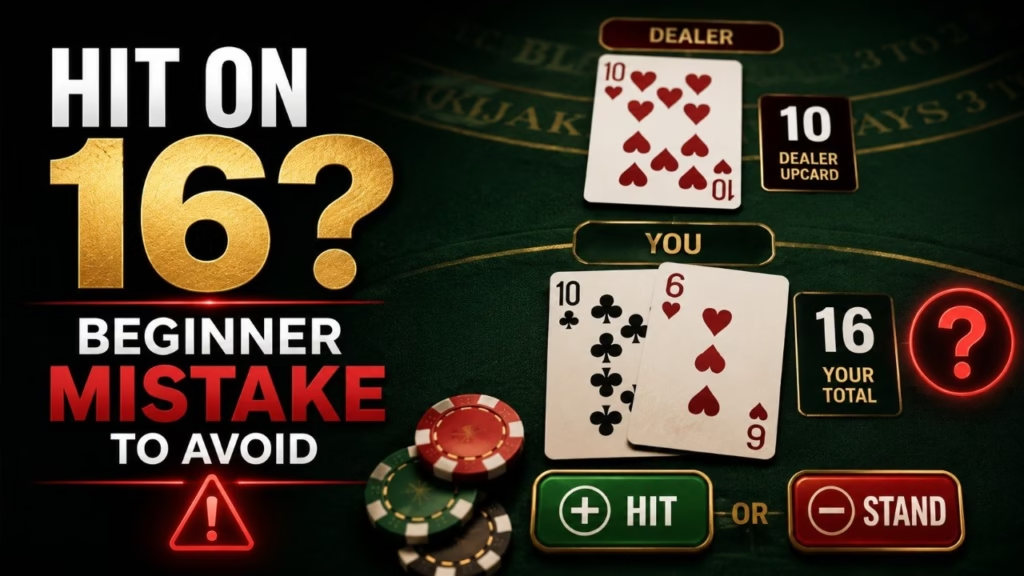
Holding a Hit on 16 in Blackjack can feel uncomfortable fast. You are close enough to 21 to worry about busting, but far enough away to lose to almost any strong dealer hand. If you are wondering should I hit on 16 blackjack, the honest answer is that the right move depends on the dealer’s upcard and the table rules, not on gut feeling.
The goal is not to “feel safe.” The goal is to make the play that gives you the best long-term result. Sometimes that means hitting a hand that looks scary. Sometimes it means standing even though your total looks weak. And in some games, surrendering is the smartest choice of all. A perfect decision can still lose, because blackjack is a game of chance with a built-in house edge.
The Math Behind the 16: Why It’s the Most Difficult Hand
 Blackjack players often call Hit on 16 in Blackjack hand. That means it is weak enough that another card can easily push it over 21, but low enough that it usually cannot win by simply standing. That is why 16 creates so much pressure for beginners.
The math is uncomfortable but simple. If you hit a hard 16, many cards help you, but many cards also bust you. If you stand, you are often hoping the dealer breaks. The problem is that the dealer will not bust every time, especially when showing strong cards. So the decision is usually about choosing the option with the smaller expected loss, not the one that feels safest in the moment.
Basic Strategy charts are built from probability theory and computer simulations. They do not promise a win on any one hand. They show the play that reduces the house edge over many hands. That is why the right move on 16 can feel counterintuitive to beginners.
The Core Rule: When to Hit and When to Stand
The standard decision on a hard Hit on 16 in Blackjack depends mainly on the dealer’s upcard. A strong dealer card changes the math because the dealer has a better chance to make a winning hand. A weak dealer card increases the chance that the dealer will bust, which makes standing more attractive.
Use this standard 6-8 deck Basic Strategy guideline for a hard 16 in a typical game where the dealer stands on soft 17. Always check the table rules, because details can vary by casino.
| Dealer Upcard | Action | Reasoning |
|---|---|---|
| 2 | Stand | The dealer is more likely to bust than with stronger cards. |
| 3 | Stand | The dealer still has a relatively higher bust chance. |
| 4 | Stand | Dealer bust odds remain favorable to you. |
| 5 | Stand | This is one of the dealer’s weaker starting cards. |
| 6 | Stand | Dealer bust probability is high enough that standing is usually best. |
| 7 | Hit | The dealer is less likely to bust, so your standing total is usually not enough. |
| 8 | Hit | You need improvement because the dealer’s hand is stronger. |
| 9 | Hit | The dealer has strong made-hand potential. |
| 10 | Hit | Standing on 16 usually loses too often here. |
| Ace | Hit | The dealer has a strong chance to make 17 or better. |
The clean rule most players remember is this: stand against dealer 2 through 6, and hit against dealer 7 through Ace. That rule is a useful shortcut, but the reason behind it matters. You are not deciding whether your 16 is “good.” You are deciding whether the dealer is likely to fail before you do.
There is one important exception that many beginner guides skip: surrender. If surrender is allowed, a hard 16 against a strong dealer card is often where that option becomes valuable.
The “Surrender” Factor: A Smarter Alternative
Surrender lets you give up the hand early and lose only part of your bet, usually half, instead of playing the hand out. Not every table offers it, and rules can differ between casinos, so check the table before you sit down.
In many standard games, surrender is especially useful when you have a hard 16 against dealer 9, 10, or Ace. Those are the situations where hitting or standing often produces a poor result, and surrender can be the mathematically better way to limit the loss.
Here is the simple logic:
- Against dealer 9, 10, or Ace: consider surrender if the table allows it.
- If surrender is not available: follow basic strategy and usually hit.
- Against dealer 2 through 6: standing is usually better than surrendering or hitting.
Many beginners ignore surrender because it feels like giving up too soon. That feeling is understandable, but blackjack strategy is not about pride. It is about choosing the least costly line over time. In the specific case of a bad 16 versus a strong dealer card, surrender can save money in the long run.
Why Your Intuition About 16 is Usually Wrong
The biggest mistake beginners make is focusing on their own total instead of the dealer’s visible card. A hard 16 feels dangerous, so the natural reaction is often to stand and “hope.” But hope is not strategy.
Fear of busting creates a strong bias. Players imagine the pain of drawing a 6, 7, 8, 9, 10, or face card and going over 21. That fear is real, but it can lead to the wrong play. In many hands, the danger of standing is greater than the danger of hitting. When the dealer shows 7 or higher, your 16 is usually behind already, so refusing to improve the hand often costs more than a bust attempt does.
On the other side, some beginners hit against weak dealer cards because they feel “stuck” with a low total. That can also be a mistake. If the dealer is showing 2 through 6, the dealer has a meaningful chance to bust. Standing lets that chance work for you.
A useful way to think about 16 is this: the hand is not asking, “Can I make 21?” It is asking, “What play gives me the best chance to beat the dealer’s final hand?” That shift in thinking removes a lot of the emotional pressure.
Helpful Interactive Tool or Visual to Add
Use this simple cheat sheet as a quick reference for the most common decision point on a hard 16. It is not a full strategy chart, but it is a fast way to remember the basic rule at the table.
| Dealer Card | Recommended Action |
|---|---|
| 2 | Stand |
| 3 | Stand |
| 4 | Stand |
| 5 | Stand |
| 6 | Stand |
| 7 | Hit |
| 8 | Hit |
| 9 | Hit |
| 10 | Hit |
| Ace | Hit |
This chart reflects standard 6-8 deck Basic Strategy. Always check house rules, such as whether the dealer hits or stands on soft 17, as this impacts strategy.
Important Variations That Change Your Strategy
Most of the time, the hard 16 rule stays the same, but table rules can slightly change the best decision in edge cases. That is why you should always read the table information before playing.
Here are the main variations that matter:
- Dealer hits or stands on soft 17: This can change the overall house edge and, in some games, affect related strategy points.
- Number of decks: Single-deck, double-deck, and shoe games can produce small strategy differences.
- Surrender availability: Not every table allows it, and the type of surrender may differ.
- Double-after-split or re-split rules: These do not usually change the basic hard 16 rule directly, but they affect the value of the table overall.
For most beginners, the practical takeaway is simple: use standard Basic Strategy for the exact game you are playing, not a generic rule from memory. If the casino posts the rules, read them. If you are unsure, ask the dealer or pit staff before you start.
Responsible Play and the Reality of Blackjack
 Even the correct move on a hard 16 will lose plenty of the time. That is not a sign that the strategy is wrong. It is a sign that blackjack includes variance, meaning short-term results can swing away from the mathematically correct choice.
Basic Strategy does not remove the house edge. It helps minimize it. That is the most important trust point for new players: there is no decision on 16 that guarantees a win, and there is no system that makes blackjack risk-free. If you decide to play, do so with money you can afford to lose, set a limit before you sit down, and avoid chasing losses.
If you are playing online or in a casino, make sure the operator is licensed where required, that you are old enough to play legally, and that you understand the table rules and any bonus terms before wagering. Small rule changes can affect the value of your decisions, especially around tough hands like 16.
FAQ
Is a 16 ever a “good” hand?
No. A hard 16 is always a weak hand in blackjack. It can still be the correct hand to stand on or surrender depending on the dealer’s upcard, but it is not a strong total on its own.
Does the number of decks change whether I should hit 16?
Usually not in a major way for the basic hard 16 rule. The standard stand-versus-hit advice is very similar across common deck counts, but some exact strategy details can shift slightly by game type.
What if I have 16 and the dealer shows an Ace?
If surrender is available, hard 16 against an Ace is often a strong surrender candidate. If surrender is not available, Basic Strategy usually says to hit.
Why do I still lose after following basic strategy?
Because blackjack has variance and a built-in house edge. Basic Strategy improves your long-term results, but it does not prevent losing hands or even losing sessions.
Are there different rules for a soft 16, like Ace + 5?
Yes. Soft hands are played differently because the Ace can count as 1 or 11 without busting you immediately. A soft 16 is not handled the same way as a hard 16, so you should not use the same rule for both.