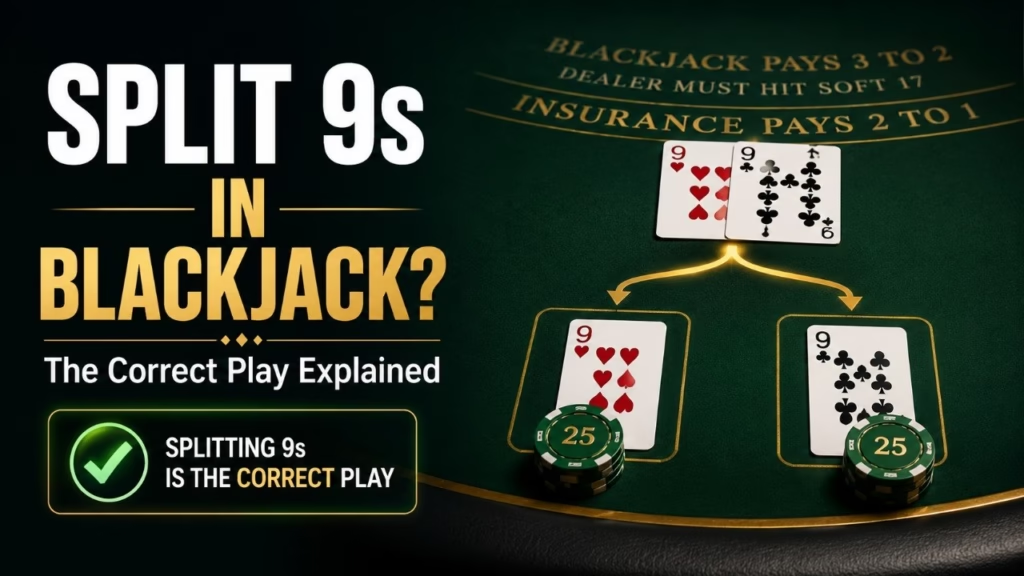
Getting dealt a pair of 9s in blackjack can feel awkward. You are close to a strong hand, but not quite there yet, and the dealer’s upcard often changes the decision. If you are asking should you split 9s in blackjack, the short answer is yes in most standard Basic Strategy situations. The goal is not to guess or chase a lucky result. The goal is to make the play with the best long-term expected value, which helps reduce the house edge over time.
The Short Answer: Should You Split 9s in Blackjack?
 Standard Basic Strategy says you should usually split 9s when the dealer shows a weak or medium-strength upcard, and stand when the dealer shows a very strong one. That decision depends on the dealer’s upcard, the table rules, and whether the game uses H17 or S17 rules.
The Core Basic Strategy
As a general rule, split 9s against dealer 2 through 6, and 8 or 9. Many Basic Strategy charts also recommend splitting against 7, while standing against 10 and Ace. The exact recommendation can shift slightly based on whether the dealer hits soft 17 (H17) or stands on soft 17 (S17), so always verify the table rules before you play.
| Dealer Upcard | Action |
|---|---|
| 2 | Split 9s |
| 3 | Split 9s |
| 4 | Split 9s |
| 5 | Split 9s |
| 6 | Split 9s |
| 7 | Stand |
| 8 | Split 9s |
| 9 | Split 9s |
| 10 | Stand |
| Ace | Stand |
Quick note: this is the standard starting point for Basic Strategy. Some rule sets and strategy charts vary slightly, especially for 7 and Ace. If you are playing in a casino or online, check whether the table uses H17 or S17 rules before relying on a printed chart.
The Math Behind the Split
A pair of 9s gives you 18, which is a decent hand. The problem is that 18 is a “stuck” total. It can beat a dealer bust or a weak finish, but it often loses to 19, 20, 21, or a dealer natural blackjack. That is why standing on 18 is not always the best long-term choice.
Splitting 9s changes the shape of the hand. Instead of one 18, you create two separate hands, each starting with a 9. Each hand then has a chance to draw a 10-value card and land on 19, which is a stronger total against many dealer outcomes. Even if one hand does not improve much, the other hand may still win. From an expected value perspective, that extra flexibility can be worth more than locking in a single 18.
This is why Basic Strategy is based on statistical game theory models and computer simulation results, not gut feeling. The question is not whether 18 “feels” safe. The question is which decision gives you the best average result over many hands.
Why Standing is Sometimes the Better Play
Standing becomes more attractive when the dealer shows a strong upcard, especially a 7, 10, or Ace. Against a dealer 7, the dealer is often in position to finish with a total around 17, which means your 18 can already be good enough to win. In that spot, splitting can reduce the value of a hand that is already competitive.
That does not mean 18 is unbeatable. It means the dealer’s upcard matters. When the dealer is likely to finish with a stronger hand, you need more than a “pretty good” total. When the dealer is more likely to bust or end weak, splitting 9s can improve your chances by giving you two chances to build a better final hand.
The Impact of Table Rules (H17 vs. S17)
 One of the most important rule differences in blackjack is whether the dealer hits soft 17 or stands on soft 17. A soft 17 is any 17 that includes an Ace counted as 11, such as Ace-6.
In S17 games, the dealer stands on soft 17. In H17 games, the dealer takes another card on soft 17. That small change can slightly alter the value of certain player decisions, including whether to split 9s in borderline situations.
For most players using standard Basic Strategy, the main split decision for 9s remains very similar across many common rule sets. Still, the exact chart you use should match the game you are playing. A strategy chart designed for S17 may not be identical to one designed for H17.
| Dealer Upcard | Action (S17 Rules) | Action (H17 Rules) | Reason |
|---|---|---|---|
| 2 | Split | Split | Dealer is weaker; two 9-based hands have better EV. |
| 3 | Split | Split | Similar logic to 2; dealer bust risk remains meaningful. |
| 4 | Split | Split | Dealer is still vulnerable to busting. |
| 5 | Split | Split | Strong split spot because dealer has a high bust rate. |
| 6 | Split | Split | One of the strongest split opportunities. |
| 7 | Stand | Stand | 18 can already be strong enough against a dealer 7. |
| 8 | Split | Split | Splitting can outperform standing on 18 in most charts. |
| 9 | Split | Split | Two 9s can compete well against a dealer 9. |
| 10 | Stand | Stand | Dealer 10 is a strong upcard; protect the 18. |
| Ace | Stand | Stand | Dealer Ace is strong, so 18 usually keeps more value as a standing hand. |
Helpful Interactive Tool: Split 9s Decision Matrix
| Dealer Card | Recommended Action |
|---|---|
| 2 | Split |
| 3 | Split |
| 4 | Split |
| 5 | Split |
| 6 | Split |
| 7 | Stand |
| 8 | Split |
| 9 | Split |
| 10 | Stand |
| Ace | Stand |
Strategy note: This matrix reflects standard Basic Strategy for common blackjack rules. Always check whether your specific table uses H17 or S17, because small rule changes can affect the best play in edge cases.
Common Mistakes When Handling Pairs
One common mistake is treating 9s as a “made” 18 and standing automatically because the hand looks decent. That is emotional thinking, not strategy. Blackjack rewards the decision with the best average value, even when that decision feels uncomfortable in the moment.
Another mistake is refusing to split because you do not want to risk two bets. If the rules allow a split and Basic Strategy calls for it, the second wager is part of the correct mathematical play. You are not increasing risk for no reason; you are choosing the higher-EV option for that specific hand.
Players also make the mistake of copying decisions from memory without checking the table rules. A strategy chart for one rule set may not be exact for another. If you are playing online or at a new casino, confirm the game conditions first.
Finally, do not let one bad result change the strategy. You can make the correct split and still lose both hands. That does not mean the play was wrong. Over the long run, correct decisions matter more than any single round.
Responsible Play and Managing Expectations
Blackjack is still a game of chance, and every hand carries financial risk. Even when you use Basic Strategy correctly, the dealer can win, and you can lose a hand that was mathematically sound. That is normal.
Basic Strategy is not a system for guaranteed profit. It is a disciplined way to reduce the house edge as much as possible under the rules of the game. If you choose to play, use only money you can afford to lose, avoid chasing losses, and set limits before you sit down.
It also helps to verify the rules of the table, including the dealer’s soft 17 rule, any restrictions on doubling after splits, and whether the casino or operator is properly licensed in your area. If you are playing online, check the game info and terms before placing real-money bets.
FAQ
Can I split 9s if the dealer shows an Ace?
Usually no. Standard Basic Strategy says to stand against an Ace rather than split 9s, because the dealer’s Ace is a strong upcard and 18 has useful value as a standing hand.
Does splitting 9s guarantee a win?
No. Splitting 9s only improves your expected value in the long run. It does not guarantee that you will win the hand.
What if I don’t have enough chips to split?
If you cannot cover the additional bet, you cannot split. In that case, you must follow the available legal action, such as standing or hitting, depending on the table rules and the hand situation.
Is it better to just take the 18?
Not usually. Against many dealer upcards, Basic Strategy prefers splitting 9s because two chances to make a stronger hand can outperform standing on 18 over time.
Should I ever double after splitting?
Sometimes, depending on the casino rules. Some tables allow doubling after splits, while others do not. Check the game rules before you play, because that restriction can affect the value of your split decision.